
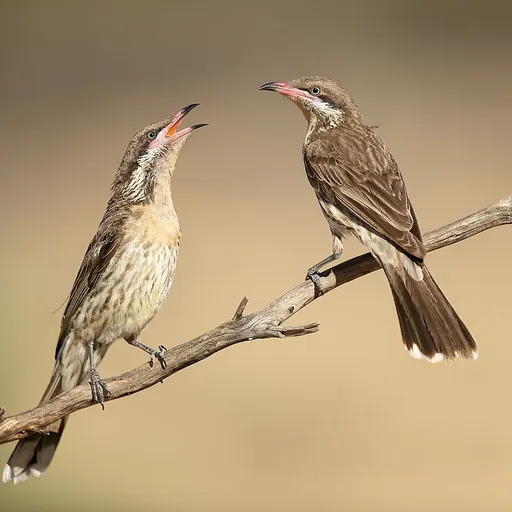
Spiny-cheeked Honeyeater
Acanthagenys rufogularis
Least Concern
Overview
The Acanthagenys rufogularis is a medium-sized bird and the sole member of its genus, endemic to Australia. Known as a frugivorous and opportunistic feeder, this species is classified as Least Concern on the IUCN Red List.
Identification
- Speckled crown with dark grey on brown plumage and a creamy-white breast featuring short, browny streaks.
- A long, dark stripe runs through the eyes to the ear coverts, with cheeks that are white with grey or brown streaks in adults, but feature a characteristic yellow sash in juveniles.
- Possesses a long, straight beak with a black tip and fleshy red or pink colouring towards the chin and gape.
- Ranges from 22 to 27 centimeters in length and weighs approximately 52 grams.
Habitat
Found throughout most of Australia, excluding Tasmania, the northern tropics, and the southeastern coast, the species inhabits deserts, coastal scrubland, dry woodlands, and mangroves. It favours sparse, woody tree environments and hummock grass areas such as beach spinifex and porcupine grass in arid and semi-arid regions, though it also utilises managed lands, orchards, and pasture lands.
Diet
Mainly frugivorous, this honeyeater also consumes nectar, blossoms, insects, reptiles, and young birds. It is an opportunist that adjusts its diet based on seasonality, favouring nectar when it is abundant in winter and spring, while insects, small lizards, and spiders also form a significant part of its food sources.
Did you know?
Juvenile spiny-cheeked honeyeaters display a characteristic yellow cheek sash, a marking that is notably less pronounced in adults, where the cheek is predominantly white with a grey or brown streak underneath.
Sources
- Wikipedia · CC BY-SA 4.0
- Wikidata · CC0 1.0