
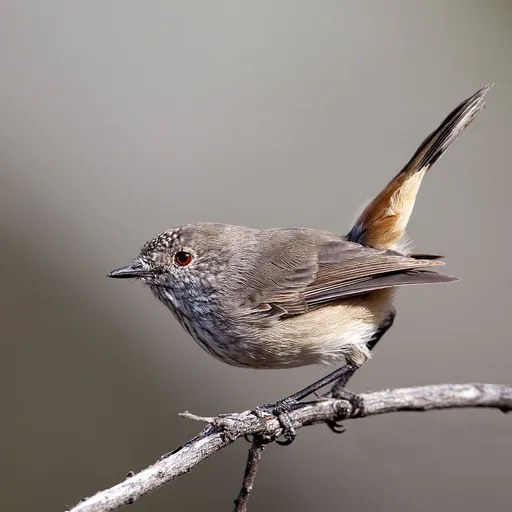
Inland Thornbill
Acanthiza apicalis
Least Concern
Overview
The inland thornbill (Acanthiza apicalis) is a passerine bird native to Australia that was originally described by John Gould. It is also known as the broad-tail thornbill and is currently classified as Least Concern on the IUCN Red List, although its population is slowly decreasing.
Identification
- Approximately 11.5 cm long, slightly larger than the similar brown thornbill.
- Grey plumage with white speckling on the forehead.
- A larger and rounder tail featuring a broad, distinct band of black tipped with white across the ends of the feathers.
- Vocalisations include a high-pitched tsee-tsee and the ability to mimic the calls of other birds, such as the pied butcherbird or willie wagtail.
Habitat
Inland thornbills inhabit a wide variety of habitats across Australia, including arid woodlands, scrubs, mulga of the Mallee, and the Gibson Desert. Despite their name, they can also be found in mangrove forests in southwestern Western Australia and in dense forests and coastal heaths. They are resident birds throughout their large distribution range and do not migrate.
Diet
Inland thornbills feed on spiders and other small insects, typically foraging in the foliage of trees and the dense understory of shrubs rather than on the ground. They are generalised feeders that usually forage in small parties or pairs, though they may occasionally join mixed flocks with other small birds.
Did you know?
Inland thornbills are proficient mimics, capable of replicating the calls of species such as the pied butcherbird, rufous whistler, and willie wagtail. They are also long-lived, with a typical lifespan of 5.7 years and one recorded instance of a bird being retrapped over seven years after its initial banding.
Sources
- Wikipedia · CC BY-SA 4.0
- Wikidata · CC0 1.0