
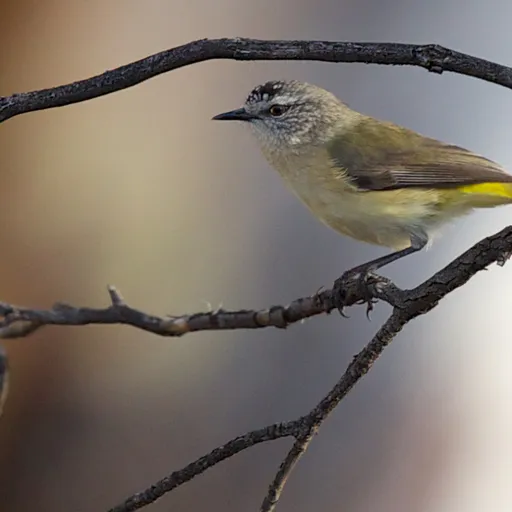
Yellow-rumped Thornbill
Acanthiza chrysorrhoa
Least Concern
Overview
The yellow-rumped thornbill (Acanthiza chrysorrhoa) is a small passerine bird belonging to the family Acanthizidae. It is the largest species within the thornbill genus, with four recognised subspecies distributed across much of Australia.
Identification
- A brownish bird measuring 9.5–12 cm in length with a distinctive yellow rump.
- Features a black forehead with white spots, a grey head and neck, a white eye-line, and a white throat.
- Possesses a long, slender, dark bill and a short tail.
- Has a distinctive high-pitched, twittering and musical song, and is known for mimicking the alarm calls of the noisy miner.
Habitat
The species inhabits a wide variety of environments, including open forest, woodland, grasslands, savannah and scrubland. Its range covers western, southern and eastern Australia as well as Tasmania, though it is absent from the north coast of Western Australia, parts of central Australia, northern Queensland and central and northern Northern Territory.
Diet
Insectivorous by nature, its diet consists mainly of ants, beetles, bugs and lerps, supplemented by spiders, flies and seeds. It typically forages in small groups of three to twelve individuals, and may also join mixed-species flocks containing other small insectivorous passerines.
Did you know?
The yellow-rumped thornbill is an early offshoot in its genus, having diverged from all other thornbills just over 10 million years ago. It is also an accomplished mimic, notably copying the alarm calls of the noisy miner.
Sources
- Wikipedia · CC BY-SA 4.0
- Wikidata · CC0 1.0