
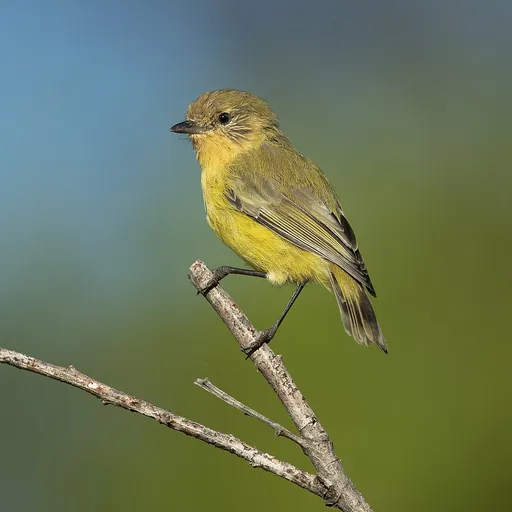
Yellow Thornbill
Acanthiza nana
Least Concern
Overview
The yellow thornbill (Acanthiza nana), formerly known as the little thornbill, is a tiny passerine bird endemic to the eastern coast of Australia. Although currently classified as Least Concern by the IUCN, the general consensus indicates that its population is decreasing.
Identification
- Around 9 cm in length with an average wingspan of 14 cm and a weight of 6–7 g.
- Greenish back feathers with olive-brown wing coverts and a dark brown-black subterminal band on the tail.
- Pale buff-orange throat and chin blending into a creamy-yellow breast, with black legs, toes, and bill.
- Loud, two-note tzid-id call that is harsher and less insect-like than that of the closely related striated thornbill.
Habitat
Found mainly in temperate and semi-arid areas, extending into the subtropical zone, the species inhabits shrublands, forests, and thickets. They prefer vegetation dominated by casuarinas or eucalypts, particularly in drier climates. Their range extends from northern and central-west Queensland, south along the eastern coast through New South Wales, Victoria, the Australian Capital Territory, and into the south-eastern corner of South Australia.
Diet
The diet consists mostly of insects, though they occasionally consume seeds. They forage by moving rapidly through the upper and middle levels of the forest canopy, searching in outer foliage or under bark, and will also catch insects mid-flight. While they can be observed in feeding flocks of up to 35 individuals or mixed-species groups, they are more commonly found in smaller groups or pairs.
Did you know?
The specific epithet nana is Latin for a 'female dwarf'. The generic name Acanthiza derives from Ancient Greek meaning 'thorn-brake' and 'live, inhabit'.
Sources
- Wikipedia · CC BY-SA 4.0
- Wikidata · CC0 1.0