
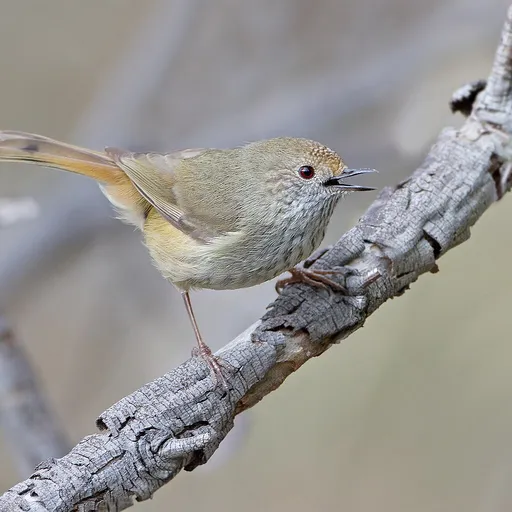
Brown Thornbill
Acanthiza pusilla
Least Concern
Overview
The brown thornbill (Acanthiza pusilla) is a small passerine bird found in eastern and south-eastern Australia, including Tasmania. It is classified as Least Concern on the IUCN Red List, though the King Island subspecies is considered critically endangered.
Identification
- Warm brown to olive-brown plumage above, with olive-buff to yellowish white flanks.
- Distinctive large dark red eyes and buff scallops on the forehead.
- Grey throat and breast with blackish streaks, a tawny rump, and a black subterminal band on the tail with paler tips.
- Small in size, ranging from 9 to 10 cm in length.
- Vocalisations described as a rich, musical warble, including mellow baritone pee-orr calls, high whistles, and cascading trills.
Habitat
This species inhabits dry forests with dense undergrowth, rainforests, shrublands, coastal dune thickets, and riverside rushes and bracken. It is usually found within 300 kilometres of the coast, living at elevations up to 1,200 m, and is common in areas such as the Blue Mountains, Great Dividing Range, and Mt Lofty Ranges.
Diet
Primarily an insectivore, the brown thornbill feeds on spiders, beetles, lerp insects, ants, and grasshoppers, occasionally consuming seeds, fruit, or nectar. It forages restlessly close to the ground and in lower trees and shrubs of the understory, often joining mixed-species feeding flocks with other thornbills, scrubwrens, warblers, and robins.
Did you know?
Brown thornbills are skilled mimics that can imitate the alarm calls of other birds, such as the New Holland honeyeater, to deter predators like pied currawongs from attacking their nests. They also respond to humans by imitating their calls.
Sources
- Wikipedia · CC BY-SA 4.0
- Wikidata · CC0 1.0