
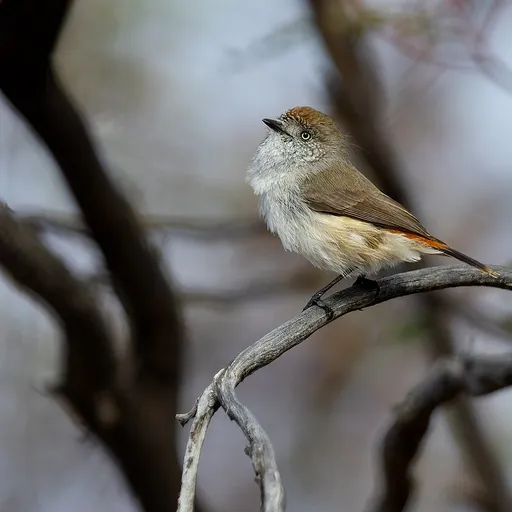
Chestnut-rumped Thornbill
Acanthiza uropygialis
Least Concern
Overview
The chestnut-rumped thornbill (Acanthiza uropygialis) is a small passerine bird in the family Acanthizidae, endemic to mainland Australia. It is a gregarious and restless species that typically lives in small flocks within dry woodland and shrubland environments.
Identification
- Length is approximately 9.8 cm with a wingspan of 15.5 cm and a weight of about 6 g.
- Plumage is pale grey-brown on the upperparts with a rich chestnut rump and a mostly black tail featuring pale tips.
- The underparts are plain whitish, accompanied by a rufous suffusion on the forehead and crown, with pale mottled ear-coverts and pale irises.
- Flight is characterised by low, undulating dashes from cover to cover, and its voice is penetrating with far-carrying song phrases.
Habitat
Found throughout inland Australia west of the Great Dividing Range, generally absent from the far north and humid southwest Western Australia. It inhabits dry woodlands and shrublands, primarily of mulga and mallee eucalypts, as well as thickets, saltbush, bluebush, lignum, and open pastoral country. The species tolerates a wide variety of land forms including sand dunes, flood plains, rocky hillsides, plateaux, and gorges.
Diet
Primarily insectivorous, the bird also consumes seeds, buds, and plant material. Foraging is predominantly by gleaning from leaves, twigs, branches, and the ground, supplemented by sallying and probing into bark for insects and spiders. It is rarely seen singly, usually foraging in small parties that may associate with other thornbills and small passerines.
Did you know?
During winter in South Australia, these birds may congregate in mixed feeding groups with yellow, yellow-rumped, and buff-rumped thornbills, forming flocks of up to 100 or more birds.
Sources
- Wikipedia · CC BY-SA 4.0
- Wikidata · CC0 1.0