
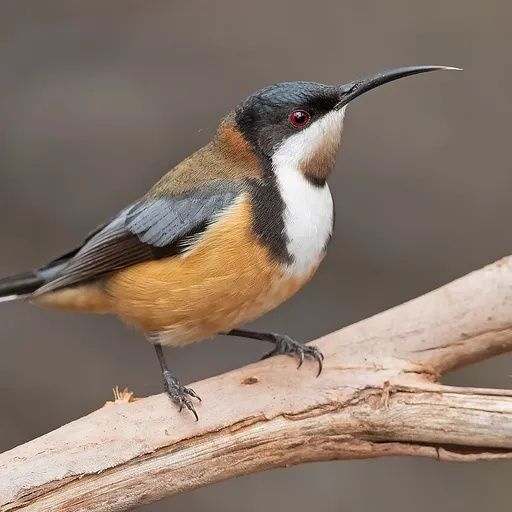
Eastern Spinebill
Acanthorhynchus tenuirostris
Least Concern
Overview
The eastern spinebill (Acanthorhynchus tenuirostris) is a species of honeyeater found in eastern Australia, ranging from Queensland to Tasmania. It inhabits forest and woodland areas as well as urban gardens that provide sufficient vegetation for cover and food.
Identification
- Approximately 15 cm long with a long, thin, downcurved black bill.
- Distinctive black, white, and chestnut plumage featuring a red eye and pale cinnamon underparts.
- Emits a clear, high-pitched, staccato piping call that sounds like "chip-chip-chip".
Habitat
Found in dry sclerophyll forest, scrub, and heathland from the Cooktown area in North Queensland south through New South Wales east of the Great Dividing Range, into Victoria, and the Flinders Ranges in eastern South Australia, as well as throughout Tasmania. The species is adaptable and can be found in urban gardens with sufficient vegetation to act as cover and a food source.
Diet
Feeds on nectar from many plants, including gum trees, mistletoes, heath, and members of the Proteaceae such as banksia, lambertia, and grevillea, as well as small insects and invertebrates. During periods of low nectar production, the bird responds by storing fat, increasing feeding time, or dropping its daytime metabolic rate to nighttime levels.
Did you know?
Recent DNA studies indicate that eastern and western spinebills belong to a clade that is a sister taxon to all other honeyeaters. The two species are believed to have evolved from a shared ancestor that retreated to refuges in the southwestern and southeastern corners of the continent during a past period of desertification.
Sources
- Wikipedia · CC BY-SA 4.0
- Wikidata · CC0 1.0