
Grey-bellied Hawk
Accipiter poliogaster
Near Threatened
Overview
The grey-bellied hawk, or grey-bellied goshawk (Accipiter poliogaster), is a fairly large and rare species of forest-dwelling South American bird of prey. Classified as Near Threatened by the IUCN, it is a member of the family Accipitridae with a wide but patchy distribution.
Identification
- A medium-sized hawk measuring 38–51 cm in body length, with females being approximately 40% larger than males.
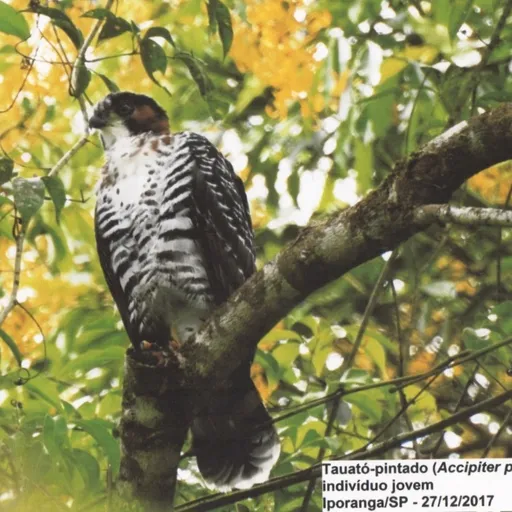
- Plumage features black or dark grey upperparts and contrasting white or grey underparts, with a pale grey belly and a 'hooded' appearance due to a black head transitioning sharply to a white throat.
- Possesses a heavy black bill with a bluish grey base, short wings and tail, and yellow feet, legs, and cere.
- A cackling call described as 'kek-kek-kek-kek-kek-kek' that trails off at the end.
Habitat
This hawk inhabits tropical lowland evergreen forests in South America, typically at elevations of 250–500 m, though it is also found in riparian forest, dense woodland, and sometimes secondary or degraded habitats. Its range covers northern and eastern Colombia, southern Venezuela, the Guyanas, Suriname, eastern Ecuador, central and eastern Peru, Amazonian Brazil, northern Bolivia, eastern Paraguay, and northeast Argentina, with accidental occurrences reported in Costa Rica.
Diet
Thought to be a still hunter, this hawk likely perches in the forest canopy to wait for passing prey rather than soaring to hunt. Its diet may comprise small passerines and tinamous, with occasional reports of young armadillos, arboreal lizards, tree frogs, and large insects.
Did you know?
Despite being a member of the genus Accipiter, the female grey-bellied hawk does not feed the nestlings, a behaviour that distinguishes it from other species in the genus where the female typically participates in feeding the young.
Sources
- Wikipedia · CC BY-SA 4.0
- Wikidata · CC0 1.0