
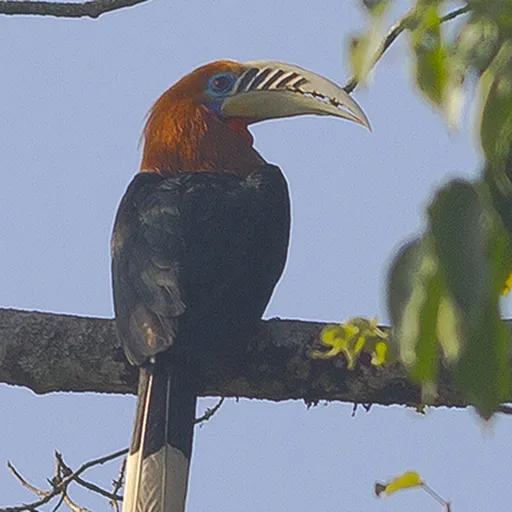
Rufous-necked Hornbill
Aceros nipalensis
Vulnerable
Overview
The rufous-necked hornbill (Aceros nipalensis) is a species of hornbill classified as Vulnerable on the IUCN Red List. It is among the largest Bucerotine hornbills, measuring approximately 117 cm in length. The species is currently listed in CITES Appendix I and is the subject of conservation initiatives such as the Hornbill Nest Adoption Programme.
Identification
- Plumage: Males feature a rich rufous colour on the head, neck, and lower body with deeper tones on the flanks and abdomen; females are predominantly black. The remaining plumage is a glossy dark green and black, with white tips on the middle primaries and the lower half of the tail.
- Bill: The beak lacks a true casque but is thickened at the base with a broken commissure. Dark ridges on the upper beak increase in number with age, reaching a maximum around seven years.
- Size: Approximately 117 cm (46 in) in length, making it one of the largest Bucerotine hornbills.
- Markings: Chestnut and black mixed lower tail-covert feathers; juvenile birds resemble adults of the same sex but lack the ridges at the base of the upper beak.
Habitat
This species occupies the northernmost distribution of its group, ranging from northeastern India and central Bhutan to western Thailand and northwestern Vietnam. It predominantly inhabits ridged and hilly forests, specifically temperate broadleaf and mixed forests at elevations between 150–2,200 m, though it has also been recorded in dry woodland. The species is locally extinct in Nepal due to hunting and habitat loss.
Diet
The rufous-necked hornbill moves between forests seasonally to forage from fruiting trees, adapting its movements to local conditions. It nests in tall trees with broad girths during the period from March to June.
Did you know?
The genus name Aceros is derived from the Ancient Greek words for 'horn-less', referencing the absence of a true casque on the beak. In Sanskrit literature, the bird is known by the epithet vārdhrīnasa, a term that has also been used to refer to other Bucerotidae.
Sources
- Wikipedia · CC BY-SA 4.0
- Wikidata · CC0 1.0