
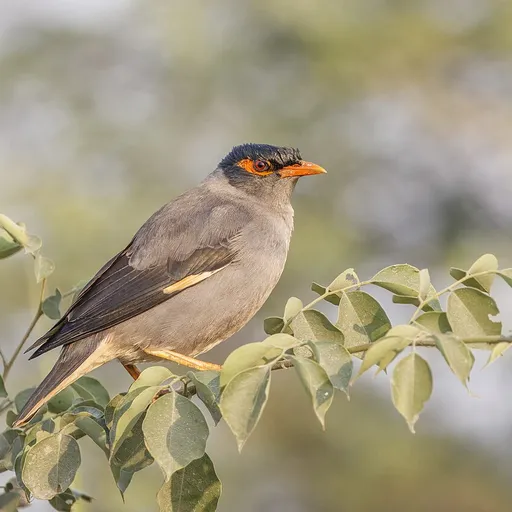
Bank Myna
Acridotheres ginginianus
Least Concern
Overview
The bank myna (Acridotheres ginginianus) is a gregarious bird found in the northern parts of South Asia, particularly the Indian subcontinent. It is closely related to the common myna but distinguished by its brick-red bare skin behind the eyes and a preference for nesting in earthen banks. The species is currently classified as Least Concern on the IUCN Red List.
Identification
- Smaller than the common myna, with a black crown and sides of the head, slaty grey upper plumage, and a lighter grey underside featuring pale pink plumage towards the abdomen.
- Distinctive brick-red naked skin behind the eyes, contrasting with the yellow skin of the common myna, paired with yellow legs and deep red irises.
- A black wing with a wing patch at the base of the primaries and pale pinkish buff tips on the outer tail feathers; a slight tuft of feathers resembles the jungle myna.
- Vociferous vocalisations include clucks, croaks, screeches, whistles, and warbling elements.
Habitat
Native range covers the Indian subcontinent from the Indus valley to the Gangetic delta, south of the lower Himalayan foothills, and includes parts of Pakistan. They favour cultivated farmland and open country near water but are also common in towns, markets, and railway stations. Their distribution is expanding southwards into India, and populations have been introduced to Kuwait, Maldives, Taiwan, and Japan.
Diet
Feeds on grain, insects, and fruits, including crop pests such as Achaea janata caterpillars and pests in wheat, sorghum, and grape crops. Forages gregariously in flocks, often following grazing animals to pick up disturbed insects or ticks, and scavenges food scraps in urban environments.
Did you know?
The species has been documented as a good predator of house flies (Musca domestica), contributing to natural pest control. Additionally, they sometimes follow catering vehicles at airports to feeding on scraps near standing aircraft.
Sources
- Wikipedia · CC BY-SA 4.0
- Wikidata · CC0 1.0