
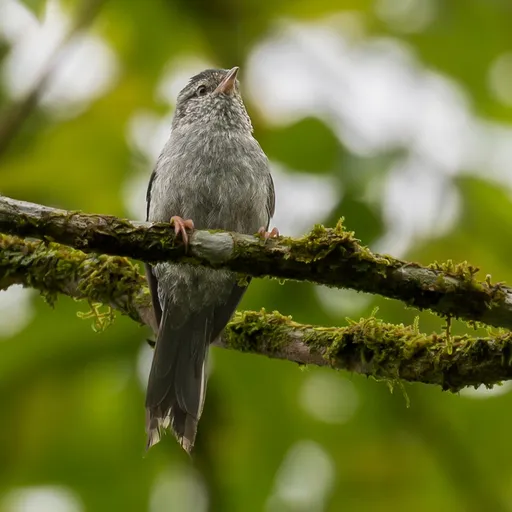
Pink-legged Graveteiro
Acrobatornis fonsecai
Near Threatened
Overview
The pink-legged graveteiro (Acrobatornis fonsecai) is a near-threatened species of bird in the family Furnariidae, endemic to the Atlantic Forest in southeastern Brazil. It is the sole member of the genus Acrobatornis and is estimated to have between 2,500 and 9,999 individuals remaining in the wild. Its survival is closely tied to the presence of local cocoa plantations, which provide a multi-layered habitat that supports its ecological needs.
Identification
- Bright-pink legs and feet, its most distinctive field mark.
- Adult plumage is mainly black and grey, while juveniles are more brown in colour.
- Approximately 14 cm (5.5 in) long, with a stout body for its size.
- Distinctive song that is high-pitched, beginning with sparse notes, accelerating, and ending with a long trill.
Habitat
Endemic to the Atlantic Forest in the southeastern part of Brazil, specifically in a region of Bahia stretching from the Rio de Contas in the north to the Rio Jequitinhonha in the south. The bird thrives in cocoa plantations, which mimic the multi-level structure of the forest canopy, allowing the species to nest in the upper shade trees and forage in the lower cocoa levels. This habitat is increasingly fragmented due to conversion to pasture and other intensive land uses.
Diet
The diet consists mainly of insects, particularly beetles (Coleoptera), along with termites, moths, ants, insect larvae, insect eggs, and spiders. Foraging is characterised by acrobatic habits, as the bird hangs upside-down under the canopies of trees while searching for food. It uses the lower levels of cocoa trees to access these food sources.
Did you know?
The scientific name Acrobatornis references the bird's acrobatic habit of hanging upside-down beneath tree canopies while foraging. The species is also known for constructing 'mock' nests in addition to its active nests; on average, 1.8 nests are built per tree, with only one used for breeding, while the smaller decoys serve to ward off predators and serve as a resource for future construction.
Sources
- Wikipedia · CC BY-SA 4.0
- Wikidata · CC0 1.0