
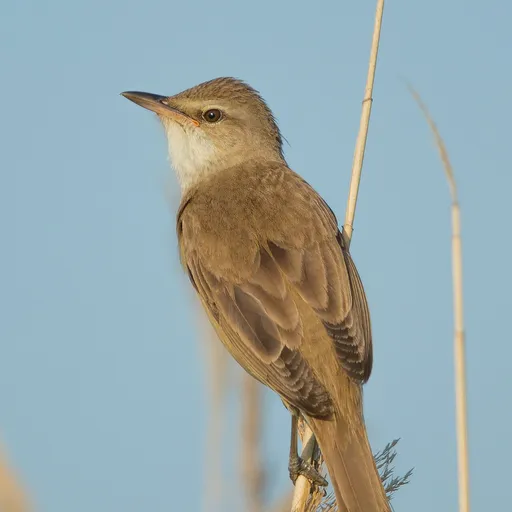
Great Reed Warbler
Acrocephalus arundinaceus
Least Concern
Listen
XC1079956 · Sonothèque ADVL · Arrondissement of Avranches (near Pontorson), Manche, Normandy, France · CC0 1.0
Overview
The great reed warbler (Acrocephalus arundinaceus) is a medium-sized passerine and the largest of the warblers in the family Acrocephalidae. It breeds throughout mainland Europe and the Western Palearctic before migrating to sub-Saharan Africa for the winter. This insectivorous bird is characterised by relatively low sexual dimorphism, with males and females appearing similar.
Identification
- Measures 16–21 cm in length with a wingspan of 25–30 cm and a weight of 22–38 g.
- Features unstreaked brown upperparts and dull buffish-white underparts, with young birds exhibiting richer buff tones below.
- Possesses a strong, pointed bill and a flattened forehead, looking like a larger common reed warbler but with a stronger supercilium.
- Produces a very loud, far-carrying song with a main phrase of chattering and croaking 'carr-carr-cree-cree-cree-jet-jet', accompanied by whistles and vocal mimicry.
Habitat
During the breeding season, the species favours large reed beds, often with some bushes, while in winter it inhabits reed beds, bush thickets, rice fields, and forest clearings. It is a migratory bird that travels between its breeding grounds in Europe and the west Palearctic and its winter quarters in tropical Africa, though it does not breed in Great Britain.
Diet
The great reed warbler has a primarily carnivorous diet, foraging for insect larvae, moths, dragonflies, damselflies, beetles, spiders, small fish, and frogs. It also consumes fruit during non-breeding seasons, and nestlings typically feed on diptera and arachnids.
Did you know?
Migratory flights over the Sahara Desert have recorded birds ascending to altitudes exceeding 5,000 m, with a maximum of 6,267 m, which are the highest recorded ascents for any passerine bird as of 2023.
Sources
- Wikipedia · CC BY-SA 4.0
- Wikidata · CC0 1.0