
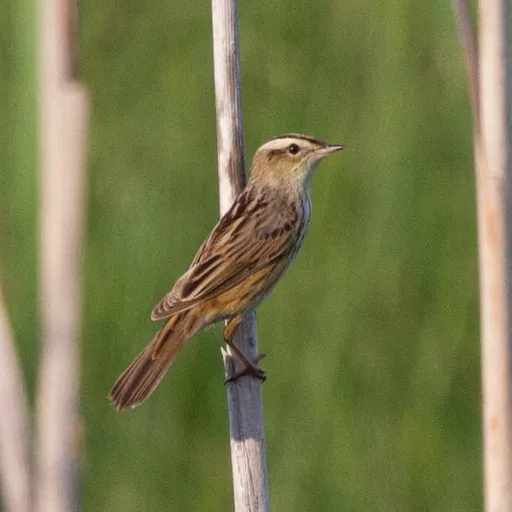
Aquatic Warbler
Acrocephalus paludicola
Vulnerable
Listen
XC1105592 · Kevin Guille · Birky, Lyubeshivs'kyi district, Volyn Oblast, Ukraine · CC0 1.0
Overview
The aquatic warbler (Acrocephalus paludicola) is a medium-sized Old World warbler found in wet sedge beds across temperate eastern Europe and western Asia. It is currently classified as Vulnerable on the IUCN Red List, with an estimated breeding population of 11,000-15,000 pairs. This migratory species winters in West Africa, having been confirmed to use the Djoudj National Bird Sanctuary in Senegal as a key wintering ground.
Identification
- Medium-sized passerine with a flattened forehead and a strong, pointed bill.
- Heavily streaked brown back with pale underparts that show variable streaking.
- Distinctive whitish supercilium and crown stripe, though the latter may cause confusion with juvenile sedge warblers.
- Song described as a fast, chattering ja-ja-ja punctuated by typical Acrocephalus whistles.
Habitat
This species breeds in wet sedge beds where vegetation remains shorter than 30 cm. Its range is primarily confined to Europe, with the Polesie region of eastern Poland and southern Belarus acting as the stronghold for 70% of the world's breeding population. It migrates to West Africa, particularly Senegal, for the winter months.
Diet
Like most warblers, it is insectivorous but also consumes other small food items, including berries.
Did you know?
The species is highly promiscuous, with most males and females having offspring with multiple partners. Its conservation status is so critical that it is the rarest and only internationally threatened passerine bird found in mainland Europe.
Sources
- Wikipedia · CC BY-SA 4.0
- Wikidata · CC0 1.0