
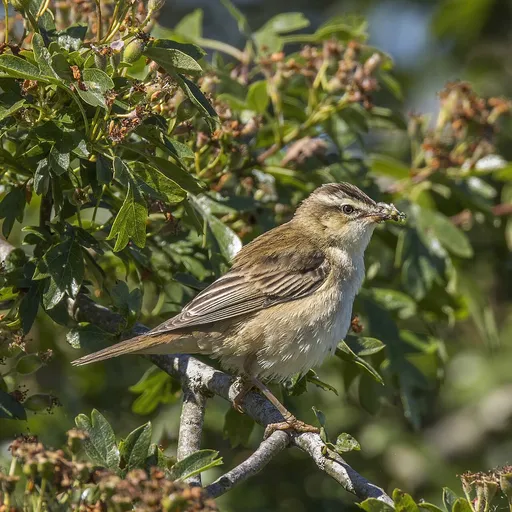
Sedge Warbler
Acrocephalus schoenobaenus
Least Concern
Listen
XC823701 · Sonothèque ADVL · Carolles, Manche, Normandie, France · CC0 1.0
Overview
The sedge warbler (Acrocephalus schoenobaenus) is a medium-sized Old World warbler in the genus Acrocephalus. It is a migratory species that breeds across Europe and Asia, spending the winter in sub-Saharan Africa. The species is currently classified as Least Concern by the IUCN.
Identification
- Size: Medium-sized, measuring 11.5–13 cm in length and weighing around 12 g.
- Plumage: Streaked brown back and wings with pale underparts; a warm brown, unstreaked rump; and a prominent whitish supercilium.
- Bill: Strong and pointed.
- Song: Varied, rushed, and chattering phrases played in random order, often including mimicry of other species.
Habitat
Breeding in reedbeds, scrub, hedgerows, and arable crops across Europe and western to central Asia, it winters in sub-Saharan Africa. Although often associated with wetlands, it can breed up to 500 metres away from water and has adapted to cool, cloudy, and moist conditions. Its range extends from the Arctic to mid-latitudes, including altitudes of 1,800–2,400 metres in Ethiopia.
Diet
Mostly insectivorous, feeding on mayflies, dragonflies, grasshoppers, and beetles, with occasional vegetable matter such as elderberries and blackberries. It forages in low, thick vegetation like reeds and rushes, picking insects from leaves or leap-catching flying prey. Before migration, it seeks out large numbers of plum-reed aphids to build fat reserves.
Did you know?
Male sedge warblers with the widest song repertoires mate with the largest number of females. They also perform 'song-flights' by rising 2–5 metres and descending in a slow, parachuting motion with wings held in a 'v' shape to attract mates.
Sources
- Wikipedia · CC BY-SA 4.0
- Wikidata · CC0 1.0