
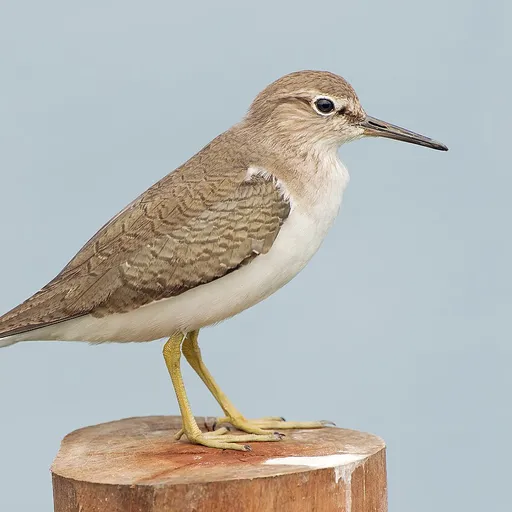
Common Sandpiper
Actitis hypoleucos
Least Concern
Listen
XC803894 · Grégoire Chauvot · Leksand, Leksand Municipality, Dalarna County, Sweden · CC0 1.0
Overview
The common sandpiper (Actitis hypoleucos) is a small Palearctic wader that breeds across most of temperate and subtropical Europe and Asia. It is the subject of the Agreement on the Conservation of African-Eurasian Migratory Waterbirds (AEWA) and is generally classified as a species of least concern, though it is vulnerable in parts of Australia.
Identification
- 18–20 cm in length with a wingspan of 32–35 cm.
- Greyish-brown upperparts and white underparts, with juveniles displaying heavier barring and buff-edged wing feathers.
- Short dark-yellowish legs and feet, and a bill featuring a pale base and dark tip.
- Winter plumage is duller with more conspicuous wing barring visible at close range.
Habitat
Breeds on the ground near freshwater in temperate and subtropical Europe and Asia, migrating to Africa, southern Asia, and Australia for the winter. Its migration route extends as far east as Palau in Micronesia, where hundreds of birds may gather for a stop-over.
Diet
Forages by sight on the ground or in shallow water for small items such as insects, crustaceans, and other invertebrates. It may also catch insects in flight while displaying a distinctive stiff-winged, low flight over the water.
Did you know?
In the Nukumanu language, the name matagakoni is considered taboo because it describes the bird's foraging movements as "bird that walks a little, then copulates," referencing the characteristic pumping tail and thrusting head.
Sources
- Wikipedia · CC BY-SA 4.0
- Wikidata · CC0 1.0