
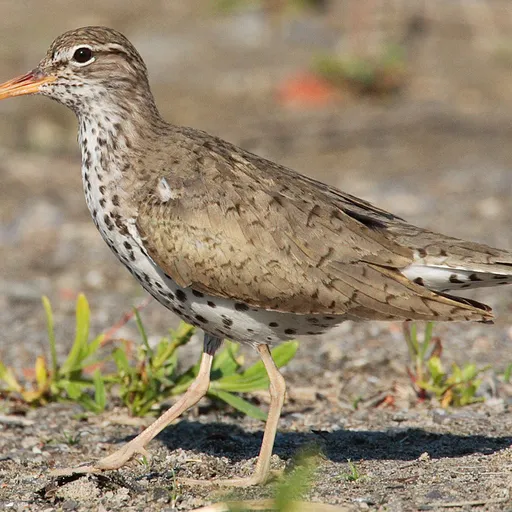
Spotted Sandpiper
Actitis macularius
Least Concern
Listen
XC1032433 · Gean Carlo Valdés · Islas secas, Panama · CC0 1.0
Overview
The spotted sandpiper (Actitis macularius) is a small shorebird that breeds across most of Canada and the United States. It is a philopatric species known for its adaptability to various environmental pressures, making it the most widespread species of its kind in North America.
Identification
- Brown above and white below with black spots on the underparts that vary in prevalence over the bird's life cycle.
- Features short yellowish legs and an orange bill with a dark tip.
- Displays a distinctive walk where the tail bobs up and down, and a stiff-winged flight low over water.
- Males and females are similar in size, but females are typically 20–25% heavier.
Habitat
Breeding habitat is near fresh water across most of Canada and the United States. They migrate to the southern United States, the Caribbean, and South America, though they are very rare vagrants to western Europe. These birds are not gregarious and are seldom seen in flocks.
Diet
Forage on the ground or in water by picking up food by sight, and may also catch insects in flight. Their diet consists of insects such as flies, beetles, and grasshoppers, along with crustaceans, invertebrates like spiders and worms, small fish, and carrion.
Did you know?
Females are polyandrous, often mating with more than one male and leaving incubation to them. Males care for the offspring, incubating eggs for about 20–23 days.
Sources
- Wikipedia · CC BY-SA 4.0
- Wikidata · CC0 1.0