
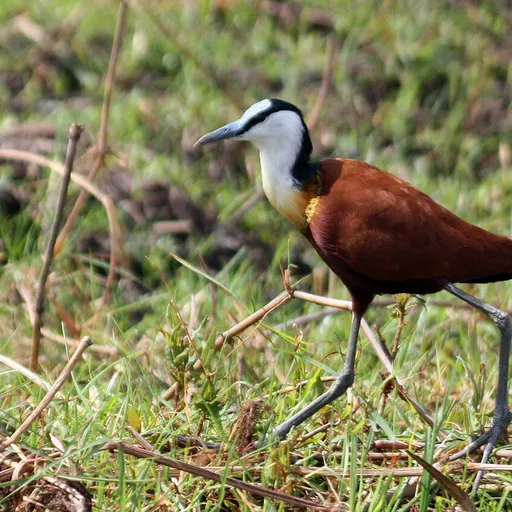
African Jacana
Actophilornis africanus
Least Concern
Overview
The African jacana (Actophilornis africanus) is a wading bird in the family Jacanidae, notable for its long toes and claws that allow it to walk on floating vegetation in shallow lakes. It is widely distributed across sub-Saharan Africa and is considered to be of Least Concern on the IUCN Red List.
Identification
- Conspicuous and unmistakable wader measuring 23 to 31 cm in length, with females being significantly larger and heavier than males.
- Chestnut upperparts with black wingtips, rear neck, and eyestripe; underparts are chestnut in adults, while juveniles have white underparts with a chestnut belly patch.
- Blue bill that extends upwards as a coot-like head shield, paired with grey legs and long toes.
Habitat
This species prefers shallow lakes with floating vegetation, where its long toes enable it to walk effectively. It is widely distributed throughout sub-Saharan Africa, where it breeds and remains sedentary apart from seasonal dispersion.
Diet
African jacanas forage on floating vegetation or the surface of the water, picking insects and other invertebrates.
Did you know?
This species exhibits a polyandrous mating system where one female mates with multiple males, and the males are solely responsible for incubating eggs and rearing the chicks. Males have evolved the remarkable ability to carry chicks underneath their wings for protection.
Sources
- Wikipedia · CC BY-SA 4.0
- Wikidata · CC0 1.0