
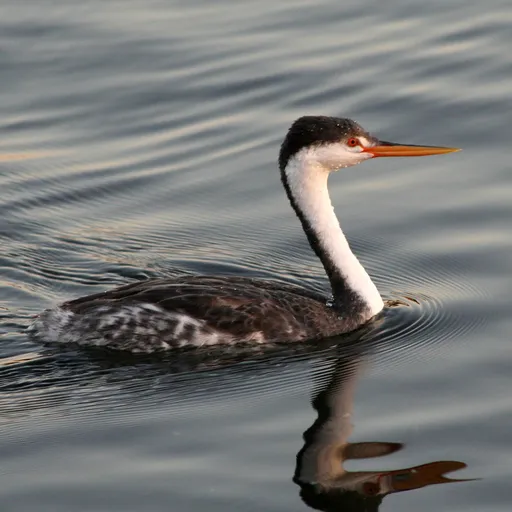
Clark's Grebe
Aechmophorus clarkii
Least Concern
Overview
Clark's grebe (Aechmophorus clarkii) is a North American waterbird in the grebe family that was historically considered a pale morph of the western grebe until the 1980s. It is listed as Least Concern on the IUCN Red List and performs the same elaborate courtship displays as its close relative.
Identification
- Features a long, slender neck with an overall paler plumage on the back compared to the western grebe, and a larger portion of its face covered in white extending above the eyes.
- Possesses a bright yellow bill in the US, which is slightly upturned, distinguishing it from the greenish-yellow, straight bill of the western grebe.
- Measures 22–29 inches (56–74 cm) in length with a wingspan of 24 inches (61 cm) and a weight of 25.3–44.4 oz (720–1,260 g).
- Males possess a slight crest on their heads, a feature not present in females.
- Produces an advertising call during courtship that sounds like a single, extended 'kreeeed', differing from the two-note call of the western grebe.
Habitat
This species nests on large inland lakes in western North America and migrates to the Pacific coast over the winter. It maintains local populations year-round in California, Nevada, and Arizona, as well as in central Mexico. Its distribution ranges from British Columbia and Saskatchewan in the north to central Mexico in the south, avoiding the Atlantic coast entirely.
Diet
Clark's grebe feeds by diving for insects, polychaete worms, crustaceans, and salamanders. Although once thought to be a fish specialist, it is an opportunist that consumes a wide variety of small items that fit the size constraints of its bill.
Did you know?
The genus name Aechmophorus translates from Ancient Greek as 'spear point bearer', a direct reference to the bird's long, dagger-like beak.
Sources
- Wikipedia · CC BY-SA 4.0
- Wikidata · CC0 1.0