
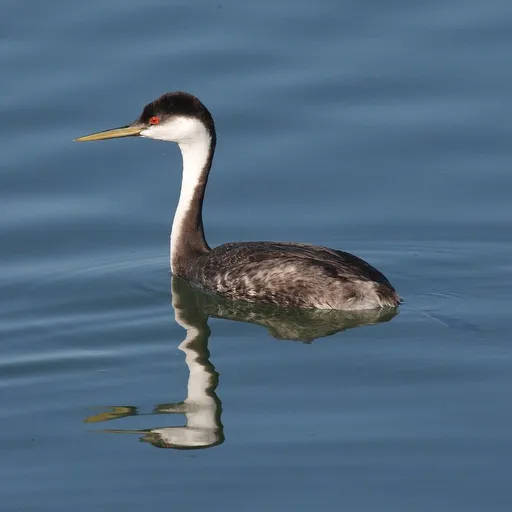
Western Grebe
Aechmophorus occidentalis
Least Concern
Overview
The western grebe is the largest North American grebe, belonging to the family of water birds. It is known by folk names such as dabchick, swan grebe, and swan-necked grebe. This species is classified as Least Concern on the IUCN Red List.
Identification
- 55–75 cm long with a 79–102 cm wingspan, featuring a long, slender, swan-like neck and red eyes.
- Black-and-white plumage with whiter flanks and paler grey backs compared to Clark's grebe.
- Black markings around the eyes and a straight greenish-yellow bill.
- Downy young are grey.
Habitat
Widespread in western North America, nesting in colonies on large inland lakes mixed with marsh vegetation and open water. Northern populations migrate west to coastal oceans in winter, while birds in the southwest and Mexico may be permanent residents.
Diet
Dives for carp, herring, mollusks, crabs, and amphibians such as salamanders, often peering below the water before diving. Smaller fish may be impaled with the bill, while others are grasped and swallowed underwater or brought to the surface to be pinched.
Did you know?
During the breeding season, western grebes perform highly elaborate courtship dances, such as the Rushing Ceremony and Weed Ceremony, which are considered the most elaborated dances among waterbird species. Parents also carry their newly hatched young on their backs, using ticking sounds to signal the chicks to hide for safety.
Sources
- Wikipedia · CC BY-SA 4.0
- Wikidata · CC0 1.0