
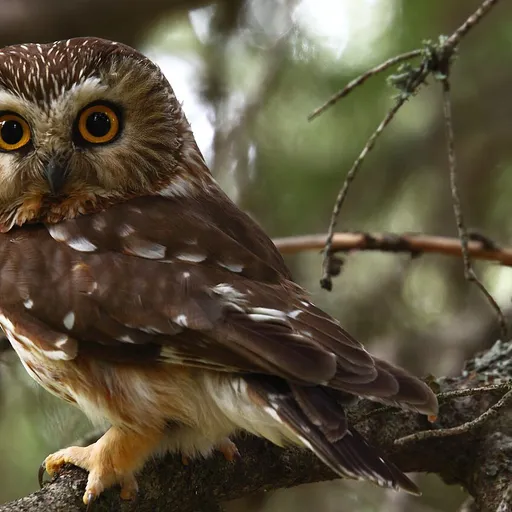
Northern Saw-whet Owl
Aegolius acadicus
Least Concern
Listen
XC707582 · Diana Doyle · Sunny Flat CG, Cave Creek Canyon, Cochise County, Arizona, United States · CC BY-SA 4.0
Overview
The northern saw-whet owl (Aegolius acadicus) is a species of small owl native to North America and one of the smallest in its range. It is a migratory bird without a strict pattern, with some individuals acting as permanent residents while others migrate south in winter or move down from higher elevations.
Identification
- Adults are 17–22 cm long with a 42–56.3 cm wingspan, similar in size to the American robin.
- They feature a round, light white face with brown and cream streaks, a dark beak, and yellow eyes.
- Upper parts are brown or reddish with white spots, while underparts are pale with dark shaded areas.
- The bird produces a repeated tooting whistle sound, often described as the rhythmic rasp of sharpening a saw on a whetting stone.
Habitat
The bird inhabits coniferous forests, sometimes mixed or deciduous woods, across North America south of the boreal forest. Most birds nest in dense coniferous forests near wetlands during the breeding season, while wintering birds prefer conifer stands or shrub thickets near water. They are secondary cavity nesters that rely on naturally occurring holes or cavities excavated by other animals.
Diet
The northern saw-whet owl has vertically asymmetrical ears that allow it to localize prey precisely by sound, enabling it to hunt in complete darkness. It mainly eats small organisms with a strong focus on small mammals, such as deer mice, voles, and shrews. While its diet consists almost exclusively of mammals, it also occasionally preys on small birds, and on the Pacific coast may eat crustaceans, frogs, and aquatic insects.
Did you know?
An adult female northern saw-whet owl was found dehydrated and hungry within the wrapped branches of the Rockefeller Center Christmas Tree during its installation in November 2020. The bird, named Rockefeller or Rocky, survived the three-day road trip from New York and gained fame when Frontier Airlines announced that her image would be featured on the aircraft tails in their fleet.
Sources
- Wikipedia · CC BY-SA 4.0
- Wikidata · CC0 1.0