
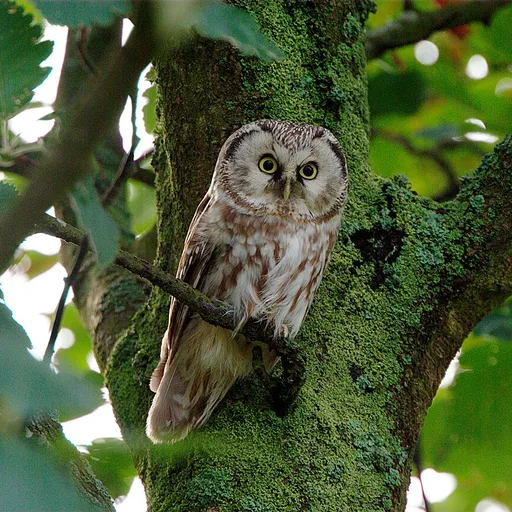
Boreal Owl
Aegolius funereus
Least Concern
Listen
XC979415 · Lubomir Wójcicki · Gmina Pawonków (near Solarnia), Powiat lubliniecki, Województwo Śląskie, Poland · CC BY 4.0
Overview
The boreal owl (Aegolius funereus), also known as Tengmalm's owl or Richardson's owl, is a small owl in the family Strigidae. It is classified as Least Concern by the IUCN Red List, though its stable population remains difficult to monitor due to its elusive nature.
Identification
- Size: Small with a large head and long wings; males measure 21–25 cm, while females are slightly larger at 25–28 cm.
- Plumage: Brown upperparts with conspicuous pearly-white spots and whitish underparts with rust-coloured streaks.
- Head: Large head with yellow eyes, an olive-brown crown with white droplets, and a dull white facial disc framed by a dark border and white 'eyebrows' that create a 'surprised' expression.
- Bill: Light yellow, distinguishing it from the dark-billed northern saw-whet owl.
Habitat
Breeds in dense boreal, subalpine forests and mixed woodland, particularly preferring old-growth forests that provide shelter and prey. Range spans the Palearctic and northern North America, including specific mountain ranges such as the Alps and the Rockies, where individuals often roost in conifers about 6 metres high.
Diet
Primarily consumes voles and other mammals such as mice, chipmunks, squirrels, gophers, moles, shrews, and bats, but also takes birds, small amphibians, insects, and other invertebrates. As an ambush predator, it waits for prey to come within 10 metres of its perch, using extreme skull asymmetry to pinpoint sounds under snow and dense vegetation.
Did you know?
Males may sing for up to 102 days during courtship to attract females and establish territory. Young owls develop bill clapping at least one week before fledging, which they use as a protective sound when disturbed.
Sources
- Wikipedia · CC BY-SA 4.0
- Wikidata · CC0 1.0