
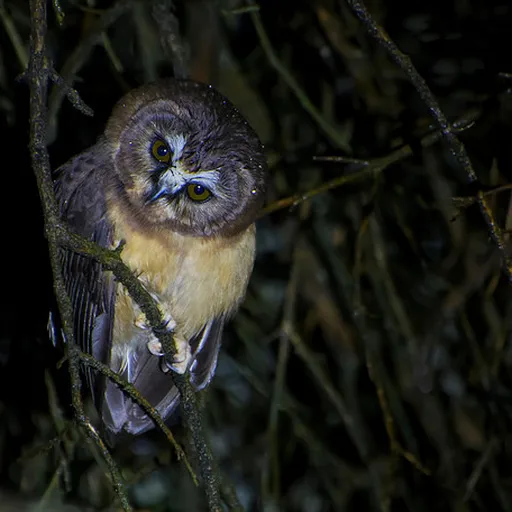
Unspotted Saw-whet Owl
Aegolius ridgwayi
Least Concern
Overview
The unspotted saw-whet owl (Aegolius ridgwayi) is a small typical owl native to mountainous areas of Central America. It resides in the IUCN Red List category of Least Concern, although its population is estimated to be decreasing.
Identification
- Size: 18 to 21.5 cm (7.1 to 8.5 in) long, weighing about 80 to 90 g (2.8 to 3.2 oz).
- Plumage: Upperparts, throat, and upper breast are plain sepia brown; lower breast and belly are plain cinnamon buff.
- Facial disk: Brown with a narrow white border; lores, chin, and 'eyebrows' are whitish.
- Eyes: Yellow.
- Song: The male's territorial call is a whistled 'hoo hoo hoo…' given about 10 times over three to five seconds, which can be confused with tree frogs of the genus Anotheca.
Habitat
Found from central Costa Rica into western Panama, with subspecies in Mexico, Guatemala, and El Salvador. It inhabits humid temperate montane forest, including humid oak forest, cloudforest, and pine-oak forest, generally within the forest canopy or near forest edges at elevations between 1,700 and 3,500 m.
Diet
The specific diet has not been detailed, but small mammals such as shrews and rodents are thought to be its primary prey. It is also thought to take birds and bats.
Did you know?
The call of tree frogs of the genus Anotheca is extremely similar to the owl's song and is easily confused with it.
Sources
- Wikipedia · CC BY-SA 4.0
- Wikidata · CC0 1.0