
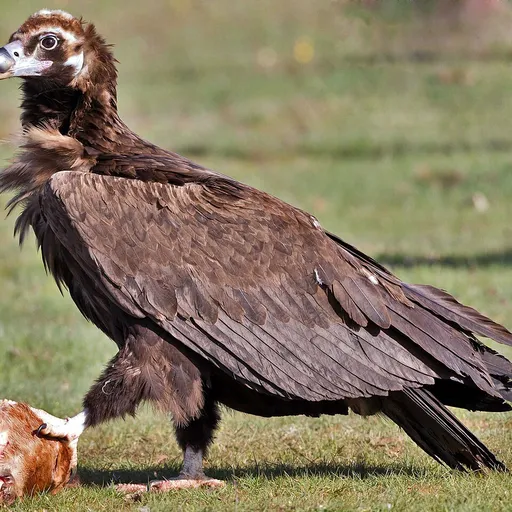
Cinereous Vulture
Aegypius monachus
Near Threatened
Listen
XC917405 · Thomas SIGNEAU · Aveyron, France · CC BY-SA 4.0
Overview
The cinereous vulture, also known as the black vulture or monk vulture, is a very large raptor and the largest member of the family Accipitridae. Classified as Near Threatened by the IUCN, this species plays a crucial ecological role in temperate Eurasian ecosystems by consuming carrion and reducing the spread of disease.
Identification
- Body length of 98–120 cm and a wingspan of 2.5–3.1 m, making it one of the heaviest flying birds in the Old World.
- Distinctly dark blackish-brown plumage that appears all black from a distance, with a pale, fine down-covered head in adults.
- Massive bill with an exposed culmen of 8–9 cm, one of the largest among living accipitrids, allowing it to break apart bones.
- Generally very silent, occasionally producing querulous mewing, roaring, or guttural cries between adults and offspring at nesting sites.
Habitat
Found across temperate Eurasia from Spain and inland Portugal through the Middle East to central Asia, including northern Manchuria, Mongolia, and Korea. It favours hilly, mountainous areas and dry semi-open habitats, often nesting near the tree line in high mountains or large forests in remote, undisturbed regions. Elevations range from 100 m in Europe to as high as 6,970 m on Mount Everest.
Diet
Primarily feeds on carrion of almost any type, including large mammals, fish, and reptiles, such as yaks, bharal, and domestic sheep. It possesses a powerful bill capable of tearing open tough skins and breaking apart bones to access flesh, dominating other scavengers at feeding sites. Occasionally preys on live animals, including calves, piglets, and nestlings of large birds.
Did you know?
The bird possesses a specialised haemoglobin alphaD subunit with high oxygen affinity, enabling it to fly at extreme altitudes such as 6,970 m on Mount Everest by efficiently extracting oxygen despite the low partial pressure in the upper troposphere.
Sources
- Wikipedia · CC BY-SA 4.0
- Wikidata · CC0 1.0