
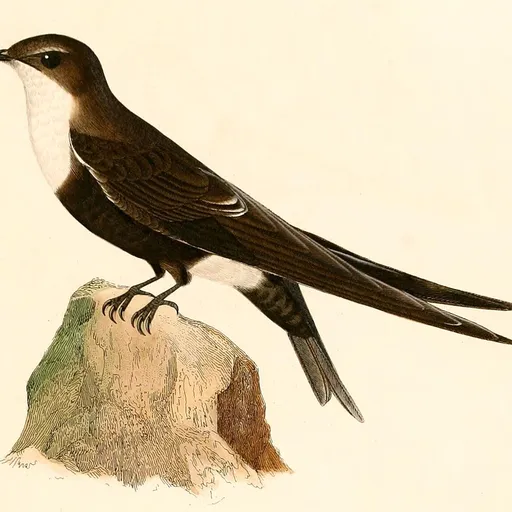
White-tipped Swift
Aeronautes montivagus
Least Concern
Listen
XC1165473 · Rosa Elena Albornoz @rosaelena_naturaleza · San Antonio De Los Altos (near Parroquia Macarao), Municipio Los Salias, Miranda, Venezuela · CC0 1.0
Overview
The white-tipped swift (Aeronautes montivagus) is a small bird in the family Apodidae, found across parts of South America. It is currently classified as Least Concern by the IUCN, with a large range and a population believed to be stable despite patchy distribution.
Identification
- A small bird measuring 12 to 13 cm in length with slim pointed wings and a long, slightly notched tail.
- Adult males of the nominate subspecies are blackish brown on the crown, upperparts, and around the eyes, contrasting with white throats, neck sides, and upper breasts.
- The tail is black-brown with wide white tips, and some wing feathers have white edges, though female white tips are reduced or absent.
- Vocalises with a distinctive, ratchet-like buzzing call described as 'j-j-j-j' or a ringing, grating chatter.
Habitat
The species is distributed across Argentina, Bolivia, Brazil, Colombia, Ecuador, French Guiana, Peru, Suriname, Venezuela, and possibly Guyana. It is mostly seen over montane evergreen forest, though it also occurs in drier intermontane valleys, with elevational limits varying between 500 and 3,200 m depending on the region.
Diet
As an aerial insectivore, the white-tipped swift feeds on flying ants, beetles, and moths. It tends to forage low over the forest but maintains ridge-top altitude in canyons, often feeding in flocks of up to 50 birds.
Did you know?
Although generally considered resident throughout its range, the white-tipped swift can disappear from some sites for months at a time. It breeds in colonies by placing nests in cliff crevices or on the sides of buildings, though the exact structure of the nest remains undescribed.
Sources
- Wikipedia · CC BY-SA 4.0
- Wikidata · CC0 1.0