
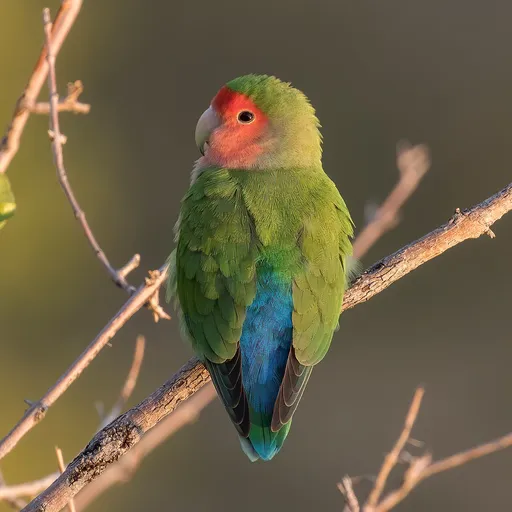
Rosy-faced Lovebird
Agapornis roseicollis
Least Concern
Overview
The rosy-faced lovebird (Agapornis roseicollis), also known as the peach-faced or rosy-collared lovebird, is a small parrot native to the savanna woodlands of Namibia. Loud and highly social, these birds often congregate in small groups and are renowned for their strong pair bonds.
Identification
- Length of 17–18 cm with a predominantly green body and a blue rump.
- Distinctive pink face and throat, which is darkest on the forehead and above the eye.
- Horn-coloured bill, brown iris, and grey legs and feet.
- Juveniles have a pale pink face, a greenish crown, and a beak with a brownish base.
Habitat
Native to dry, open country in southwest Africa, ranging from southwest Angola through Namibia to the Orange River valley in South Africa. They inhabit broad-leaved woodland, semi-desert, and mountainous areas up to 1,600 m elevation, and depend on the presence of water sources. Feral populations established from escaped pets also occur in metropolitan Phoenix, Arizona, and on Maui and the Big Island in Hawaii.
Diet
The diet consists mainly of seeds and berries, with birds feeding throughout the day and gathering in flocks of hundreds when food is plentiful. They can act as pests in agricultural areas, feeding on crops such as millet.
Did you know?
Rosy-faced lovebirds are the first species in the family Psittacidae to pass the mark test, demonstrating the ability to recognise their own reflection in a mirror. Females are also noted for tearing raw materials into long strips and 'twisty-tieing' them onto their backs to transport nesting material to their nests.
Sources
- Wikipedia · CC BY-SA 4.0
- Wikidata · CC0 1.0