
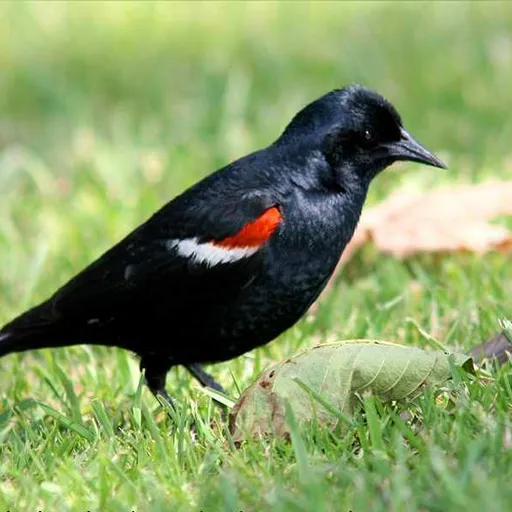
Tricolored Blackbird
Agelaius tricolor
Endangered
Overview
The tricolored blackbird (Agelaius tricolor) is a passerine bird of the family Icteridae, currently classified as Endangered on the IUCN Red List. It is a highly social species that forms the largest colonies of any North American landbird, often comprising tens of thousands of individuals.
Identification
- Males display distinctive white stripes beneath red shoulder patches, or 'epaulets', which are clearly visible when the bird is flying or displaying.
- The call is described as slightly more nasal than that of the red-winged blackbird, consisting of a nasal 'kip' and a sharp 'check'.
- The male song is characterised by a garbled 'on-ke-kaaangh'.
Habitat
The range is restricted to the coastal areas of the Pacific coast of North America, stretching from Northern California, with occasional strays into Oregon, to upper Baja California in Mexico. Originally found in wetland cattails and bulrushes, the species has adapted to use non-native vegetation, such as Himalayan blackberry brambles, and agricultural fields, particularly grain fields within dairy farms.
Did you know?
Like the extinct passenger pigeon, the colonial nesting behaviour of the tricolored blackbird makes it particularly vulnerable to extinction, as harvesters can destroy thousands of flightless chicks within minutes by running through fields during the breeding season.
Sources
- Wikipedia · CC BY-SA 4.0
- Wikidata · CC0 1.0