
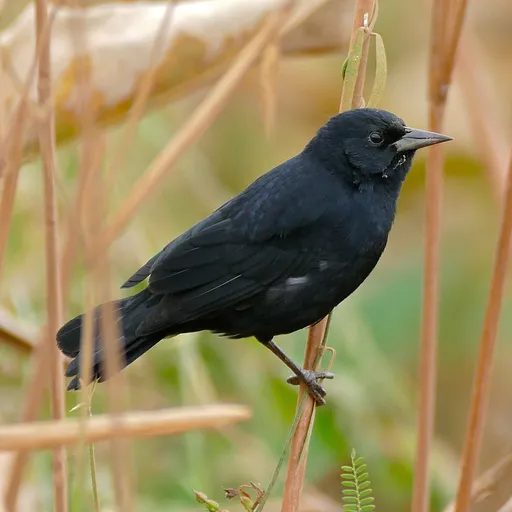
Unicolored Blackbird
Agelasticus cyanopus
Least Concern
Overview
The unicolored blackbird (Agelasticus cyanopus) is a sedentary species in the family Icteridae found across parts of South America, including Argentina, Bolivia, Brazil, Paraguay, and Uruguay. It is assessed by the IUCN as being of Least Concern, with a stable population and no immediate threats identified.
Identification
- Males are entirely black with a faint bluish gloss, while adult females display sexual dimorphism with plumage ranging from pale yellow underparts with dusky streaks to dark olive, depending on subspecies.
- The species measures 18 to 21 cm in length, with males weighing an average of 40.6 g and females 37.4 g.
- Both sexes possess a dark brown iris and black legs, though adult males have a black bill whereas females often exhibit bluish gray to pale horns on the mandible.
- Vocalisations consist of alternating liquid shr-r-le rattles interspersed with repeated warbles or trills, with a contact call sounding like 'chieg'.
Habitat
The unicolored blackbird primarily inhabits marshes and wetlands featuring abundant floating and emergent vegetation, such as water-cabbage, duckweed, sedge, and cat-tail. It also utilises nearby grasslands, croplands, and low streamside vegetation, typically ranging in elevation from sea level to 500 m. Its distribution is disjunct across eastern Bolivia, southern and eastern Brazil, Paraguay, northern Argentina, and Uruguay, with vagrant records in Peru.
Diet
This bird feeds primarily on insects, small vertebrates such as fish, and seeds, with arthropods comprising a smaller portion of its diet. During the non-breeding season, corn and other crop seeds become a significant food source. Foraging involves walking on floating vegetation to pick prey from the water and plants, or searching on the ground, often in flocks that can exceed 100 individuals outside the breeding season.
Did you know?
The nest is constructed from wet plant material that feels like cardboard when dry and is built in cat-tails or reeds typically within 1.7 m of the water surface. The shiny cowbird is a common brood parasite of the species.
Sources
- Wikipedia · CC BY-SA 4.0
- Wikidata · CC0 1.0