
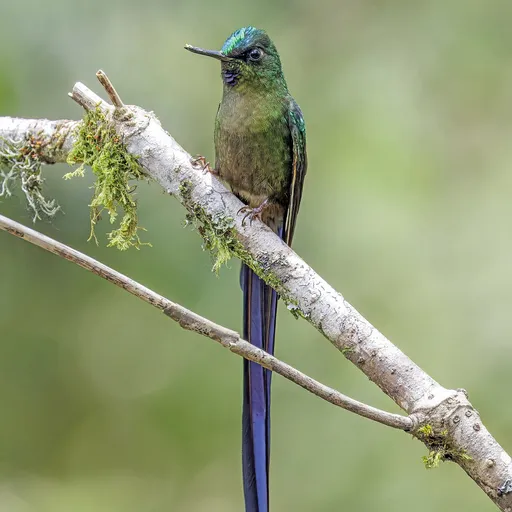
Violet-tailed Sylph
Aglaiocercus coelestis
Least Concern
Overview
The violet-tailed sylph, Aglaiocercus coelestis, is a species of hummingbird in the coquettes tribe, Lesbiini. It is found in Colombia and Ecuador and is assessed as Least Concern by the IUCN, although its population is believed to be decreasing.
Identification
- Males feature a shining green crown and back that transitions to violet-blue on the rump, with a violet-blue gorget and long, iridescent metallic violet outer tail feathers with blue tips.
- Females possess a glittering blue crown with a whitish spot behind the eye, a white throat with green spots, and cinnamon-rufous underparts separated by a white band.
- The species weighs between 4.6 and 5.2 g, with males ranging from 18 to 21 cm in length due to their long tails, while females measure 9.5 to 9.7 cm.
- Both subspecies have a short black bill, and their song is described as a continuous series of short notes, 'psit..psit..psit..'.
Habitat
This bird inhabits cloudforest and semi-open landscapes, including transitions between forest and grassland and areas with trees and shrubs. It is most numerous at an elevation of about 1,000 m but ranges from 300 m to 2,100 m. The nominate subspecies is found in the Pacific slope of Colombia's Western Andes and north-central Ecuador, while subspecies A. c. aethereus occupies the Andes' Pacific slope in southwestern Ecuador.
Diet
The violet-tailed sylph feeds on nectar and small insects, foraging mostly near the ground but occasionally ascending to the canopy. It employs trap-lining around a circuit of flowering plants and hovers or clings to flowers to feed. Insects are caught by hawking from a perch or by gleaning from vegetation.
Did you know?
Both sexes contribute to building the nest, which is a dome of moss and spiderweb with a side entrance. These nests are also used by the birds as night roosts outside of the breeding season.
Sources
- Wikipedia · CC BY-SA 4.0
- Wikidata · CC0 1.0