
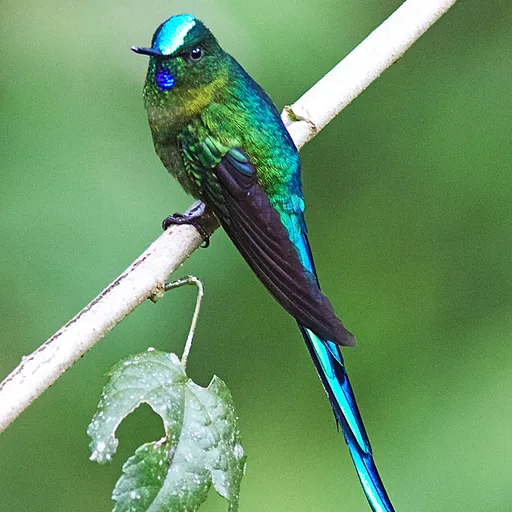
Long-tailed Sylph
Aglaiocercus kingii
Least Concern
Overview
The long-tailed sylph (Aglaiocercus kingii) is a species of hummingbird found in South America, specifically within the 'coquettes' tribe. It inhabits open landscapes and forest edges across several Andean countries and is currently assessed as a species of Least Concern by the IUCN.
Identification
- Males of the nominate subspecies display a shining emerald green crown, metallic bronzy green upperparts, and a blue or violet throat.
- Females feature a metallic green head with a white malar stripe, a white to buffy throat with green speckles, and cinnamon underparts.
- The species has a short black bill and exhibits striking sexual dimorphism in tail length, with males possessing very long outer tail feathers.
- Vocalisations include a continuous series of buzzy notes, short raspy 'dzzrt' calls, and a thin high-pitched rising twittering.
Habitat
The species inhabits generally open landscapes such as scrublands, forest clearings, gardens, secondary forest, and high-elevation grassland. Its distribution spans Venezuela, Colombia, Ecuador, Peru, and Bolivia, with populations found at elevations between 900 and 3,000 m.
Diet
The long-tailed sylph feeds on nectar and insects, employing strategies such as trap-lining around flowering plants, defending territories, hovering, and robbing nectar by piercing flower bases. It catches insects by hawking from a perch, foraging mostly in treetops at lower elevations but closer to the ground in elfin forests and high-elevation grassland.
Did you know?
Despite its common name, the bird's tail is not noticeably longer than those of the other sylphs.
Sources
- Wikipedia · CC BY-SA 4.0
- Wikidata · CC0 1.0