
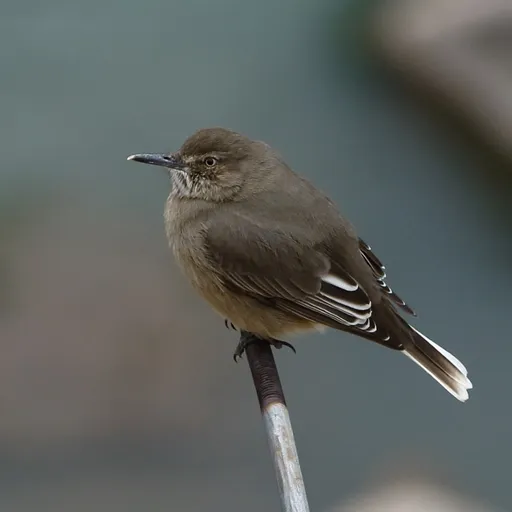
Black-billed Shrike-Tyrant
Agriornis montanus
Least Concern
Listen
XC249492 · Niels Krabbe · Tungurahua: 1 km SE Lag. del Tambo, Cordillera de los Llanganates, Ecuador · CC BY-SA 4.0
Overview
The black-billed shrike-tyrant (Agriornis montanus) is a species of tyrant flycatcher found across the Andes of South America. It inhabits a wide variety of open, high-elevation landscapes, ranging from grasslands to the edges of Polylepis forest. Classified as Least Concern by the IUCN, it is considered the most common and widespread shrike-tyrant in Peru, though it remains wide-ranging but not especially numerous in Ecuador.
Identification
- Length of 22 to 24 cm with a hooked black bill and blackish legs and feet.
- Plumage varies by subspecies, but the nominate features dark grayish brown upperparts, ashy brown breasts, and white cheeks streaked with brown.
- Tail feathers are blackish centrally with white outer feathers that have dark bases on the inner webs.
- Vocalisations include a loud, ringing wheee or wheeeu and a rising wee? call, sung more frequently at dawn.
Habitat
This species occupies open, generally high-elevation habitats from the upper temperate zone into the páramo, including Puna grassland, rocky slopes, and areas with scattered bushes or perches like fences. Its elevation range typically lies between 3,000 and 4,500 m, though it extends down to 2,500 m in some regions and rarely to sea level in Chile. Its range spans the Andes from Colombia through Ecuador, Peru, Bolivia, and Argentina, with unconfirmed vagrant records from the Falkland Islands.
Diet
The black-billed shrike-tyrant maintains an eclectic diet consisting of insects, small mammals, reptiles, amphibians, bird eggs, nestlings, and seeds. It usually forages alone, perching on rocks, bushes, or fence posts to hawking prey in mid-air or taking it from the ground. Occasionally, it hovers before dropping onto its target.
Did you know?
Males perform an aerial courtship display that produces a faint, low-pitched whirr made by their tail feathers. The species often nests in human structures, placing its large cup of sticks and grass lined with wool in roof openings or wall crevices.
Sources
- Wikipedia · CC BY-SA 4.0
- Wikidata · CC0 1.0