
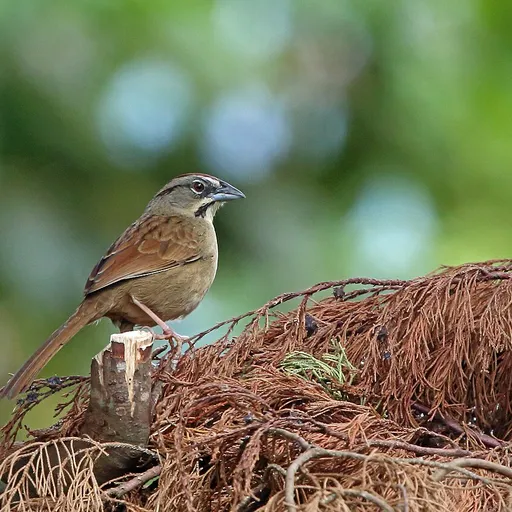
Rusty Sparrow
Aimophila rufescens
Least Concern
Overview
The rusty sparrow (Aimophila rufescens) is a species of New World sparrow found from Mexico to Costa Rica. It is classified as Least Concern by the IUCN, with an estimated stable population of at least 500,000 mature individuals.
Identification
- Adults of the nominate subspecies feature a chestnut crown with black streaks and a thin olive-grey or buffy central stripe, set against an olive-greyish face with a white eye-ring and dark brown lores.
- Measuring 16.5 to 20 cm in length and weighing 34 to 48 g, the bird has a black upper bill, a greyish-blue lower bill, and brown to brownish-pink legs.
- In northern Central America, the song is described as a rich, liquid 'cheet-cheet-swing-you!' or 'sweet-sweet-to'you!', while in Costa Rica it sings a bright 'cheet, chee-chee-chee-chee yew'.
- Calls include a gruff, dry scolding 'chrrr-rrr-rrr' or 'grrr-grr-grrr' alongside 'tzee', 'chip', and 'tzeek' sounds.
Habitat
The species occupies a disjunct range across western and southern Mexico, Central America, and parts of Costa Rica, inhabiting pine-oak forest, the edges and shrubby clearings of deciduous forest, scrublands, and pine savanna. It ranges in elevation from sea level to 2,700 m, though it is rare in Costa Rica, where it is confined to grassy slopes dotted with boulders, dense shrubs, and small trees between 500 and 1,100 m.
Diet
Although not extensively studied, the rusty sparrow is thought to feed on seeds, insects, spiders, fruits, and occasionally nectar. It forages on the ground, usually singly or in pairs.
Did you know?
The species was formally described in 1827 as Pipilo rufescens by William Swainson, who initially placed it among the towhees, before it was reclassified into its current genus in 1840.
Sources
- Wikipedia · CC BY-SA 4.0
- Wikidata · CC0 1.0