
Mandarin Duck
Aix galericulata
Least Concern
Overview
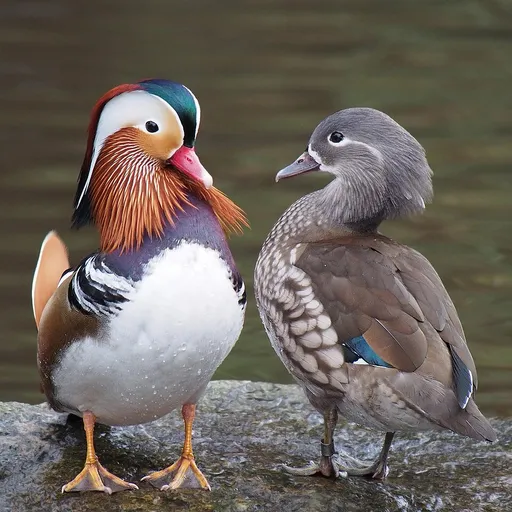
The mandarin duck (Aix galericulata) is a perching duck species native to East and Northeast Asia, closely related to the North American wood duck. It is a medium-sized bird that is sexually dimorphic, with elaborately coloured males and females of more subdued plumage.
Identification
- Size: Medium-sized duck, 41–49 cm long with a 65–75 cm wingspan; smaller than most dabbling ducks.
- Male plumage: Purple breast with two vertical white bars, ruddy flanks, reddish face and "whiskers", large white crescent above the eye, and two orange 'sail' feathers at the back.
- Female plumage: Greyish-brown plumage with a slender white eye-ring and stripe running back from the eye, a small white flank stripe, and a pale tip to the bill.
- Bill: Small and red on breeding males; eclipse plumage males retain a bright yellow-orange or red beak but lack the crest.
Habitat
Native to East and Northeast Asia, the mandarin duck prefers the dense, shrubby forested edges of rivers and lakes, mostly in low-lying areas but breeding in valleys up to 1,500 m. In winter, it also uses marshes, flooded fields, and open rivers, occasionally coastal lagoons. A large introduced population now exists in the British Isles, where it inhabits the edges of lakes, water meadows, and cultivated areas with woods nearby.
Diet
Mandarin ducks feed by dabbling or walking on land, primarily consuming plants and seeds such as beech mast and acorns, alongside snails, insects, and small fish. Their diet is seasonal, shifting to acorns and grain in autumn and winter, and insects, snails, fish, and aquatic plants in spring. They forage mainly near dawn or dusk, perching in trees or on the ground during the day.
Did you know?
Mandarin ducks exhibit conspecific brood parasitism, laying eggs in the nests of their own relatives or other species; in the Zuojia Nature Reserve in Northeast China, 46.1% of mandarin ducks were found to practise this behaviour.
Sources
- Wikipedia · CC BY-SA 4.0
- Wikidata · CC0 1.0