
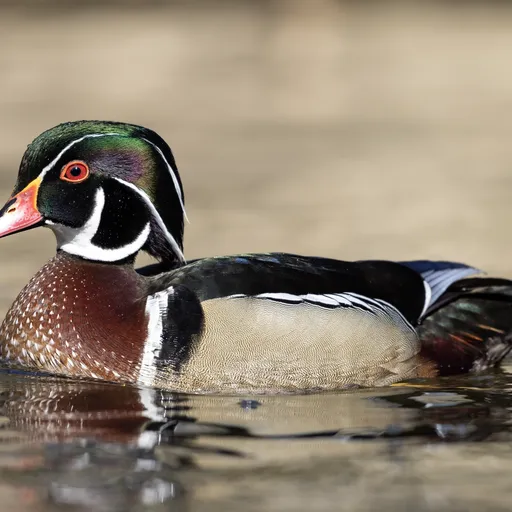
Wood Duck
Aix sponsa
Least Concern
Listen
XC177728 · Jonathon Jongsma · Powderhorn Park, Minneapolis, Hennepin, Minnesota, United States · CC BY-SA 4.0
Overview
The wood duck, or Carolina duck (Aix sponsa), is a medium-sized, partially migratory perching duck native to North America. It is recognised for the male's stunning, multicolored iridescent plumage, making it one of the most visually striking waterfowl species in the continent.
Identification
- Medium-sized duck, approximately 47–54 cm long, with a wingspan of 66–73 cm.
- Adult males display iridescent plumage, red eyes, a white neck flare, and a crested head; females have a white eye-ring, whitish throat, and a similar crest.
- Both sexes possess sharp claws adapted for perching on branches.
- Males produce a rising whistle described as "jeeeeee," while females emit a rising squeal of "do weep do weep" when flushed and a sharp "cr-r-ek" as an alarm call.
Habitat
Wood ducks inhabit wooded swamps, shallow lakes, marshes, ponds, and creeks across the eastern United States, the US West Coast, parts of southern Canada, and the west coast of Mexico. They are year-round residents in southern regions, while northern populations migrate south to the US Atlantic Coast for winter. The breeding range has recently expanded toward the Great Plains, with the Mississippi alluvial valley currently hosting most breeding activity.
Diet
Wood ducks are omnivores that forage by dabbling on water surfaces or grazing on land. Their diet consists mainly of berries, acorns, and seeds, supplemented by insects. They are capable of swallowing acorns whole and crushing them within their gizzard.
Did you know?
Wood duck ducklings are precocial and, the day after hatching, climb to the nest opening and jump to the ground or water from heights of up to 50 feet, surviving by landing in water or on soft material such as leaf litter. They are the only North American duck species that can produce two broods in a single season in southern regions.
Sources
- Wikipedia · CC BY-SA 4.0
- Wikidata · CC0 1.0