
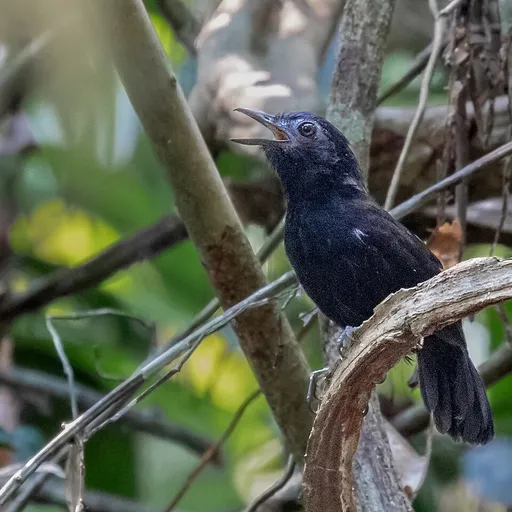
White-shouldered Antbird
Akletos melanoceps
Least Concern
Overview
The white-shouldered antbird (Akletos melanoceps) is a species of typical antbird found in the western Amazon Basin. It is classified as Least Concern by the IUCN, with a stable population and no immediate threats identified.
Identification
- Length of 17 to 18.5 cm with a weight of 36 to 40 g.
- Males are mostly black with a small white shoulder patch usually visible only in flight.
- Females have a black head, neck, and upper breast, with rufous upperparts and cinnamon-tawny underparts.
- Both sexes feature a ring of bare blue skin around the eye and a red iris.
- Song is described as a short series of notes becoming more intense, transcribed as "pur, pee-ur pee-ur pee-ur pee-ur".
Habitat
This species inhabits the floor and understorey of várzea evergreen forest, transitional forest, and mature secondary forest. It primarily favours shrubby, vine-tangled areas immediately adjoining rivers. Its range extends from south-central Colombia through eastern Ecuador and Peru into western Brazil.
Diet
The bird feeds on insects and probably other arthropods, foraging on the ground and within 5 m of it. It captures prey by reaching, lunging from perches, and short flutter-flights, and occasionally joins army ant swarms or mixed-species feeding flocks.
Did you know?
The species has a complex taxonomic history, having been moved between the genera Myrmeciza and Inundicola before being assigned to the older, pre-existing genus Akletos in 2014 following molecular phylogenetic studies.
Sources
- Wikipedia · CC BY-SA 4.0
- Wikidata · CC0 1.0