
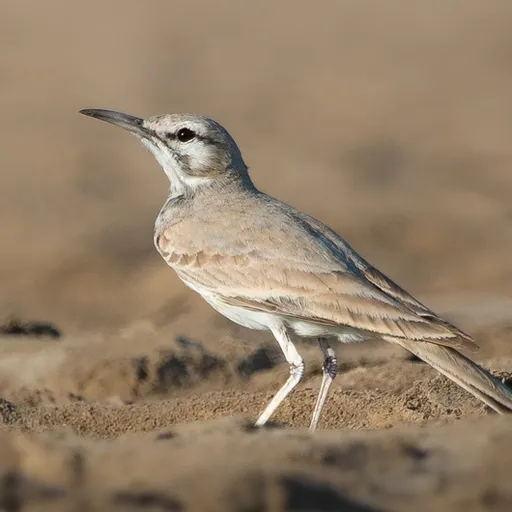
Greater Hoopoe-Lark
Alaemon alaudipes
Least Concern
Overview
The greater hoopoe-lark is a large passerine bird that serves as a breeding resident in arid, desert, and semi-desert environments. Formerly known as the bifasciated lark or large desert lark, it is classified under the genus Alaemon, a name derived from the Greek word for 'wanderer'.
Identification
- Large, slender-bodied and long-legged with a distinctive down-curved bill.
- Sandy grey upper-parts and buffy white underparts, featuring a spotted breast and a dark facial mask with whisker-like lines under the eyes.
- Flight reveals striking black wing feathers with white bases and trailing edges, alongside a white tail with black outer feathers.
- Song consists of rising and falling trilled whistles and clicks, transcribed as 'tee-tee-tee' followed by a prolonged 'tee-hoo', accompanied by a typical rolling 'zreee' call.
Habitat
It inhabits arid, desert, and semi-desert regions across a vast range starting from the Cape Verde Islands, moving through much of northern Africa and the Arabian Peninsula, and extending eastwards to Syria, Afghanistan, Pakistan, and India.
Diet
This species feeds on insects, other invertebrates, small lizards, seeds, and the fruiting bodies of certain fungi. It forages by running or walking in spurts while probing and digging the ground.
Did you know?
The slow, flappy start of the male's song flight resembles that of a hoopoe, which is why the species is named the greater hoopoe-lark despite belonging to a different family. Additionally, these birds are capable of living in very arid conditions and may shelter in the burrows of Uromastyx lizards during the heat of the day.
Sources
- Wikipedia · CC BY-SA 4.0
- Wikidata · CC0 1.0