
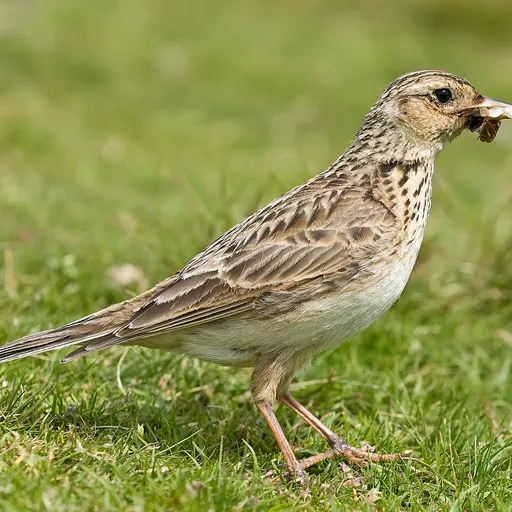
Eurasian Skylark
Alauda arvensis
Least Concern
Listen
XC791228 · Carlo Fracasso · Macchiagodena, Province of Isernia, Molise, Italy · CC0 1.0
Overview
The Eurasian skylark (Alauda arvensis), often referred to as the lark, is a passerine bird in the family Alaudidae that breeds across Europe, Asia and North Africa, with introduced populations in Australia, New Zealand, Canada and Hawaii. It is a widespread species classified as Least Concern on the IUCN Red List, known for its open farmland habitats and the male's remarkable singing flight.
Identification
- Plumage is dull greyish-brown above and on the breast, with a buff-white belly and a short blunt crest that can be raised or lowered.
- In flight, the short tail and rear edges of the wings show white edging, though this is only visible when the bird is flying away from the observer.
- Males possess broader wings than females, an adaptation for efficient hovering during song displays.
- The male sings a clear, bubbling warble while hovering 50 to 100 metres in the air, a performance that can last up to 20 minutes during the later mating season.
Habitat
The species inhabits open farmland and heath, breeding across most of Europe, Asia and the mountains of North Africa, with introduced populations in parts of Oceania, North America and the Pacific. Birds in the western range tend to be resident, while eastern populations are more migratory, though many western birds move to lowlands and the coast in winter.
Diet
The Eurasian skylark forages by walking over the ground to search for food on the soil surface, consuming insects and plant material such as seeds and young leaves. Insects constitute an important part of the diet in summer, and the bird swallows seeds without removing the husk, unlike finches.
Did you know?
The male's song is so high and long that it can last for 20 minutes or more, and the bird often appears as just a dot in the sky while perching between 50 and 100 metres above the ground.
Sources
- Wikipedia · CC BY-SA 4.0
- Wikidata · CC0 1.0