
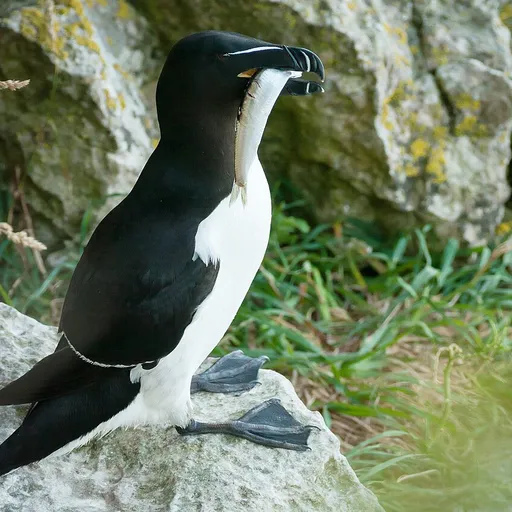
Razorbill
Alca torda
Least Concern
Overview
The razorbill (Alca torda) is a North Atlantic colonial seabird and the sole extant member of the genus Alca. It is the closest living relative of the extinct great auk and leads a predominantly aquatic lifestyle, coming to land only to breed.
Identification
- Primarily black plumage with a white underside, featuring a thin white line extending from the eyes to the bill tip.
- A large, thick-set bird for its group, with a black bill that is deep, laterally compressed, and blunted at the end with vertical grooves.
- Body length of 37–39 cm with a distinctly long tail during the incubation period that is not common among auks.
Habitat
Razorbills are distributed across the sub-arctic and boreal waters of the North Atlantic, breeding on islands, rocky shores, and cliffs from eastern North America to western Europe. They prefer water surface temperatures below 15 °C and commonly move into larger estuaries with lower salinity levels to feed, unlike many other auks.
Diet
Their diet consists mainly of mid-water schooling fish such as capelin, sandeels, juvenile cod, sprats, and herring, occasionally including crustaceans and polychaetes. They forage by diving with semi-folded wings and streamlined bodies, typically at depths of 25 m but capable of reaching 120 m.
Did you know?
A razorbill ringed in the UK in 1967 survived for at least 41 years, setting the longevity record for the species despite an average lifespan of roughly 13 years.
Sources
- Wikipedia · CC BY-SA 4.0
- Wikidata · CC0 1.0