
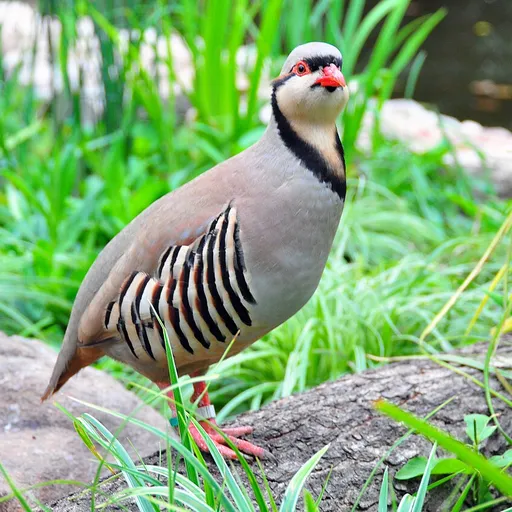
Chukar Partridge
Alectoris chukar
Least Concern
Overview
The chukar partridge (Alectoris chukar) is a Palearctic upland gamebird belonging to the pheasant family, Phasianidae. Native to Asia, it has been introduced to many other locations where feral populations have established, including parts of North America, Malta, and New Zealand. It is currently classified as Least Concern by the IUCN Red List.
Identification
- Rotund body measuring 32–35 cm in length with a light brown back, grey breast, and buff belly.
- Distinctive black and white bars on the flanks and a black band running from the forehead across the eye down the head to enclose a white throat.
- Possesses a coral red bill and red legs, with sexes similar in appearance except the female is slightly smaller and lacks a spur.
- Emits a noisy song described as 'chuck-chuck-chukar-chukar', which gives the bird its common name.
Habitat
The native range spans Asia, including regions from the Middle East to the western Himalayas, as well as southeastern Europe. It inhabits rocky open hillsides with grass, scattered scrub, or cultivation, typically avoiding areas of high humidity or rainfall. Altitudes vary significantly, from below sea level in parts of Israel and Jordan to as high as 4,000 m in more eastern areas.
Diet
Chukar partridges consume a wide variety of seeds and some insects, also ingesting grit to aid digestion. While seeds of Eragrostis were dominant in Kashmir and Bromus tectorum favoured in the US, the species adjusts its diet based on local availability. Birds feeding on succulent vegetation can meet their water requirements, though they visit open water sources during the summer.
Did you know?
The chukar holds cultural significance in Hindu mythology, where it is known as Chakor and symbolises intense, unrequited love, supposedly due to its constant gazing at the moon. Additionally, chick chukars provide a key model for understanding the evolution of avian flight, as they utilise wing-assisted incline running before their first flight.
Sources
- Wikipedia · CC BY-SA 4.0
- Wikidata · CC0 1.0