
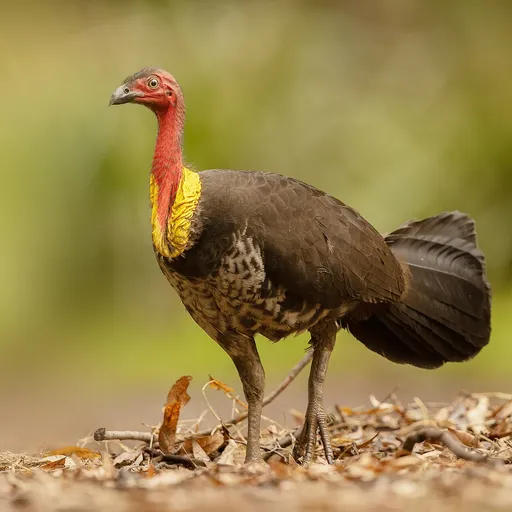
Australian Brushturkey
Alectura lathami
Least Concern
Overview
The Australian brushturkey (Alectura lathami) is a large, mound-building bird of the family Megapodiidae and the largest living member of the group. Despite its name, it is not closely related to American turkeys or Australian bustards.
Identification
- A large bird with a total length of 60–75 cm and a wingspan of about 85 cm, predominantly blackish in colour.
- Features a bare, bright red head and a yellow wattle in the nominate subspecies, or a purple wattle in the northern subspecies.
- Possesses a prominent, fan-like tail that is flattened sideways.
- The underside of the body is sprinkled with white feathers, which become more pronounced in older birds.
Habitat
Found in eastern Australia ranging from Far North Queensland to the south coast of New South Wales, and introduced to Kangaroo Island. It inhabits rainforests, wet sclerophyll forests, drier scrubs, and open areas in both mountainous and lowland regions. The species has successfully adapted to urban environments, commonly nesting in suburban gardens and backyards in cities such as Brisbane and Sydney.
Diet
The Australian brushturkey exhibits opportunistic feeding behaviour, foraging on the ground by raking up material to find food. In urban areas, it scavenges food waste, including rubbish from bins and discarded scraps, and is known to boldly steal food from picnic tables and raid compost bins.
Did you know?
The eggs are hatched by the heat of composting mounds built from leaves and earth, with the male parent checking the temperature by sticking its beak into the mound to maintain it between 33–35 °C. Unlike in reptiles, incubation temperature in these birds influences the sex ratio through differential embryo mortality rather than determining the sex of the developing embryos directly.
Sources
- Wikipedia · CC BY-SA 4.0
- Wikidata · CC0 1.0