
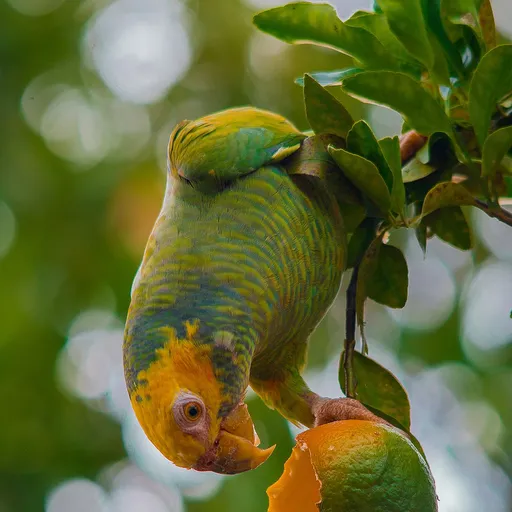
Yellow-faced Parrot
Alipiopsitta xanthops
Near Threatened
Overview
The yellow-faced parrot (Alipiopsitta xanthops) is a Neotropical parrot and the sole species within its genus, once classified under Amazona but now recognised as distinct. It is a semi-nomadic species primarily found in the cerrado region of Brazil, though it has been downlisted from Vulnerable to Near Threatened by the IUCN following conservation efforts.
Identification
- Predominantly green and yellow plumage with a distinct yellow crown, lores, cheeks and auriculars in adults; immatures exhibit less yellow on the head.
- Measures approximately 27 cm in length with a stocky body and short tail.
- Yellowish-horn bill featuring a dark culmen, accompanied by a pinkish cere and yellow iris.
- Light grey legs with no sexual dimorphism in plumage or size between males and females.
Habitat
This species inhabits the cerrado on the Brazilian plateau and the drier Caatinga scrubland, with a range extending from Maranhão and Piauí in the north to São Paulo and Mato Grosso do Sul in the south. Its distribution is semi-nomadic, with limited records from northeastern Bolivia, though it is absent from Paraguay despite previous listings. It has suffered significant habitat loss due to conversion to agricultural land but persists in fragmented habitats and protected areas.
Diet
The yellow-faced parrot forages on the fruit and seeds of trees such as Anacardium, Salacia crassifolia and Astronium fraxinifolium, and is also known to raid crops of mango and unripe guava. Termites constitute another component of its diet.
Did you know?
Its genus name, Alipiopsitta, was adopted only after the previously proposed name Salvatoria was found to be pre-occupied by a group of polychaete worms from the superfamily Nereidoidea. Breeding occurs between May and October, with nests situated in the hollows of termite mounds, where eggs are incubated for 19 to 22 days.
Sources
- Wikipedia · CC BY-SA 4.0
- Wikidata · CC0 1.0