
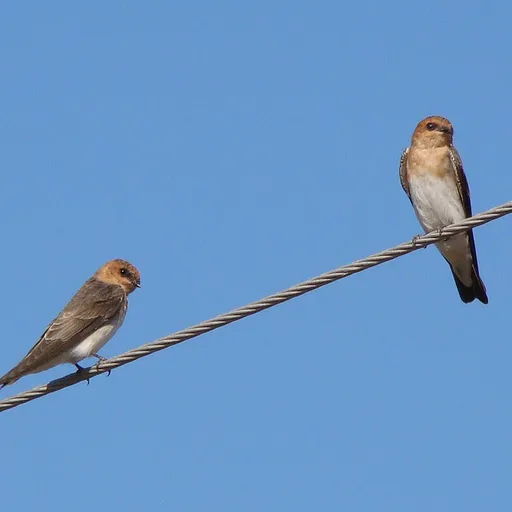
Tawny-headed Swallow
Alopochelidon fucata
Least Concern
Overview
The tawny-headed swallow (Alopochelidon fucata) is a small species of bird in the family Hirundinidae and the only member of its genus. It is classified as Least Concern on the IUCN Red List.
Identification
- Measures approximately 12 cm in length and weighs between 13 and 15 g, with a black bill ranging from 6.6 to 8.1 mm.
- Features a brownish-black crown with tawny-rufous edges, a tawny-rufous forehead and hindcrown, and cinnamon-buff ear coverts, throat, and breast.
- Upperparts are gray-brown with a paler rump, dark brown wings and tail, and dull white underparts with pale gray-brown sides.
- Juveniles have a more buff head and less rufous feathers compared to adults.
- Emits a soft trilled flight call described as 'treeeeb'.
Habitat
Native to Argentina, Bolivia, Brazil, Colombia, Paraguay, Peru, Uruguay, and Venezuela, with vagrant records in Chile and the Falkland Islands. It inhabits dry savannas, subtropical or tropical seasonally wet or flooded lowland grasslands, open areas near small bodies of water, forest clearings near streams, and pampas, typically at altitudes up to 1,600 m.
Diet
This swallow feeds primarily on insects such as beetles, flies, and hymenopterans. It usually forages in pairs or small groups, though groups of up to 100 individuals have been recorded outside the breeding season, and it has occasionally been seen with wintering barn swallows.
Did you know?
The genus name Alopochelidon combines the Ancient Greek words for 'fox-like' and 'swallow', while the species epithet fucata is Latin for 'painted'. It nests in cup-shaped structures built from leaves, feathers, and straw inside hidden holes along rivers, streams, and ditches that are at least 1 m deep.
Sources
- Wikipedia · CC BY-SA 4.0
- Wikidata · CC0 1.0