
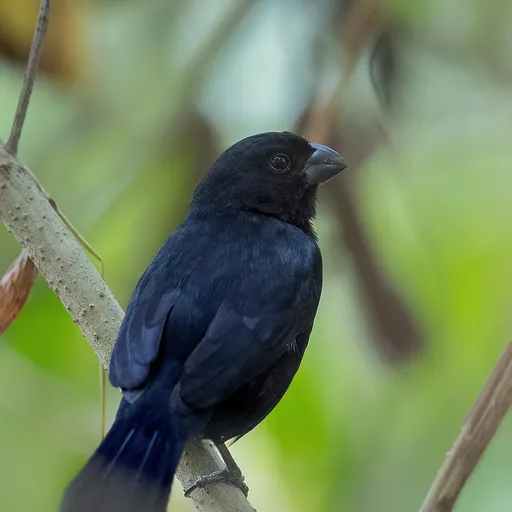
Blue Seedeater
Amaurospiza concolor
Listen
XC864626 · Ana Rebeca Martinez Martinez · Monte Albán, Santa Cruz Xoxocotlán, Oaxaca, Mexico · CC0 1.0
Overview
The blue seedeater (Amaurospiza concolor), also known as Cabanis's seedeater, is a small bird in the cardinal family found in southern Mexico and Central America. The species comprises two subspecies, with the nominate form extending from Chiapas to Panama and the relicta subspecies restricted to southwestern Mexico.
Identification
- Length of 11.5 to 14 cm and a weight of 12 to 15 g.
- Nominate males are entirely slate blue, while females have cinnamon upperparts and tawny underparts.
- The A. c. relicta male is more slaty with black lores, and its female counterpart is a paler cinnamon.
Habitat
The bird inhabits openings in and edges of humid montane and secondary forests, with a strong preference for sites featuring bamboo. Elevation ranges from 600 to 2,500 m in northern Central America, narrowing to 1,700 to 2,200 m in Costa Rica.
Diet
Its diet consists of insects, seeds, and bamboo shoots.
Did you know?
The only known nest, discovered in Mexico, was a cup of coarse grass lined with finer grass and contained two seedeater eggs alongside one egg from the brood parasite bronzed cowbird (Molothrus aeneus).