
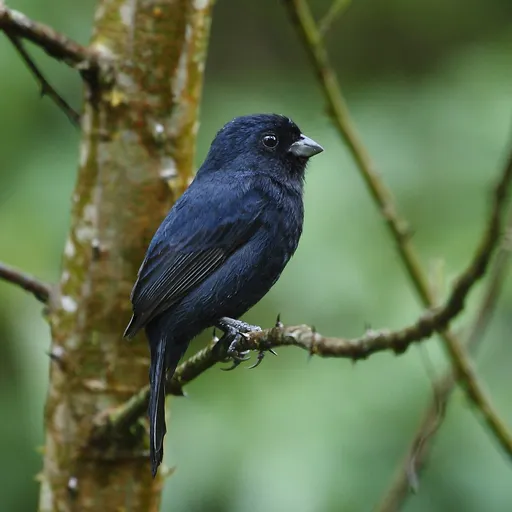
Blackish-blue Seedeater
Amaurospiza moesta
Least Concern
Overview
The blackish-blue seedeater (Amaurospiza moesta) is a small passerine bird belonging to the family Cardinalidae, formerly placed in the finch family Emberizidae. It is a monotypic species found primarily in South America. While it is currently listed as Least Concern by some sources, it faces potential population declines due to habitat degradation.
Identification
- Measures 12 to 12.5 cm in length and weighs between 12.5 and 14 g.
- Males are entirely dark slaty blue, appearing darker on the face and underparts.
- Females are tawny brown with underparts that are paler than the upperparts.
- Song is described as a pleasant warble, accompanied by calls resembling "psit" or "pix".
Habitat
Primarily distributed in southeastern Brazil, adjoining eastern Paraguay, and northeastern Argentina, with scattered records further north in Brazil. It inhabits woodland undergrowth and edges, showing a strong preference for Chusquea and Guadua bamboo. Its elevation range extends from sea level up to 1,600 m.
Diet
The species feeds primarily on bamboo seeds, likely supplemented by other seeds and insects. It forages singly or in pairs, ranging from the ground up to approximately 3 m in height.
Did you know?
Breeding does not appear to be strictly seasonal but instead relies on the availability of bamboo seeds, with breeding activity observed in April, August, September, November, and December.
Sources
- Wikipedia · CC BY-SA 4.0
- Wikidata · CC0 1.0