
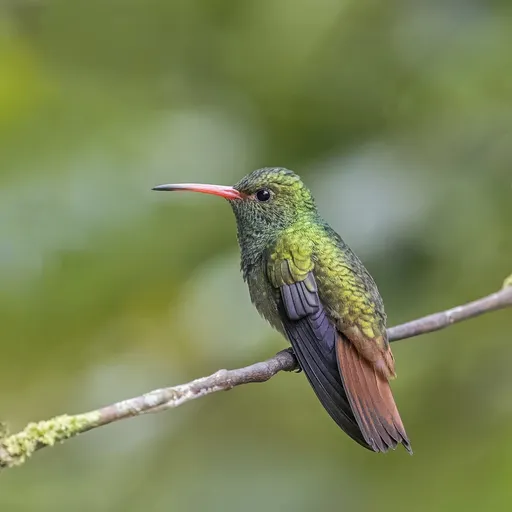
Rufous-tailed Hummingbird
Amazilia tzacatl
Least Concern
Listen
XC1031788 · Gean Carlo Valdés · Islas secas, Panama · CC0 1.0
Overview
The rufous-tailed hummingbird (Amazilia tzacatl) is a medium-sized member of the emeralds tribe found across east-central Mexico, Central America, and northern South America. Listed as Least Concern by the IUCN, the species has a very large range with a population estimated at more than five million mature individuals, though numbers are currently decreasing.
Identification
- Measures 9 to 11 cm in length and weighs approximately 5 g, with a bill that has a black outer maxilla and red inner half.
- Adult males feature a green head and upperparts, with chestnut-brown lores, uppertail coverts, and a tail that is mostly chestnut-brown with bronze-green tips and outer webs.
- The throat, upper breast, and sides are green, with throat feathers sometimes showing thin white edges that create a scalloped effect; the lower breast is gray and the belly is white.
- Song is described as a varied, high, thin, squeaky chirping, while calls include a hard, smacking tchik-tchik and dry, hard chips that can turn into a rattling chirr.
Habitat
This species inhabits open, non-forested landscapes such as clearings, gardens, and forest edges, as well as low, young, brushy secondary forests. Its range extends from east-central Mexico through Central America into Ecuador, Venezuela, and Colombia, reaching elevations from sea level up to 2,500 m, with local or seasonal occurrences at higher altitudes.
Diet
Feeding on nectar and small insects, the rufous-tailed hummingbird is commonly seen at sugar water feeders, in coffee and banana plantations, and at flower patches. It is extremely territorial and aggressive at these feeding sites, often chasing away other hummingbirds and large insects.
Did you know?
The female is entirely responsible for nest building, incubation of two white eggs, and the care of nestlings. The compact cup nest is constructed from plant fibers, leaves, and spiderwebs, and is covered with lichens and mosses to blend in.
Sources
- Wikipedia · CC BY-SA 4.0
- Wikidata · CC0 1.0