
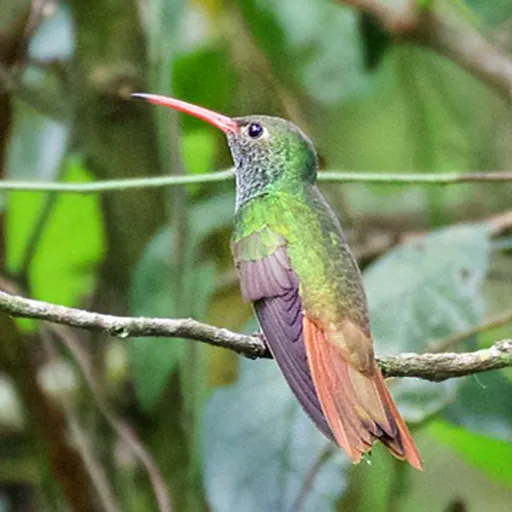
Buff-bellied Hummingbird
Amazilia yucatanensis
Least Concern
Overview
The buff-bellied hummingbird (Amazilia yucatanensis) is a species of hummingbird belonging to the tribe Trochilini. It is classified as Least Concern by the IUCN Red List, with a population that has been increasing since at least the 1980s.
Identification
- Length of 10 to 11 cm with a weight of 2.9 to 4.7 g.
- Adult males possess metallic bronze green upperparts that are duller on the crown, alongside a bright metallic yellowish emerald green chin, throat, and chest.
- The vent area and undertail coverts are deep cinnamon rufous, while the tail feathers are chestnut at the base and metallic bronze at the end.
- Adult males have a rosy reddish bill that is dusky at the end, whereas females have more dark coloration on the maxilla.
Habitat
This species inhabits a variety of semi-open to open and dry landscapes, including scrubby woodlands, thorn forest, oak woodlands, and urban or suburban parks. Its range covers Belize, Guatemala, Mexico, and parts of the United States, with specific subspecies distributed across northern Belize and northwestern Guatemala, southern Texas, and central to southern Mexico.
Diet
The buff-bellied hummingbird feeds on nectar from a wide variety of flowering plants, shrubs, and trees, including those with non-tubular blossoms, by hovering rather than perching. It also consumes small arthropods captured on the wing or gleaned from vegetation.
Did you know?
The species constructs its cup-shaped nests from plant and other fibers such as thistledown, grass, hair, and even nylon, all bound together with spiderweb and camouflaged with lichens and bark shreds.
Sources
- Wikipedia · CC BY-SA 4.0
- Wikidata · CC0 1.0