
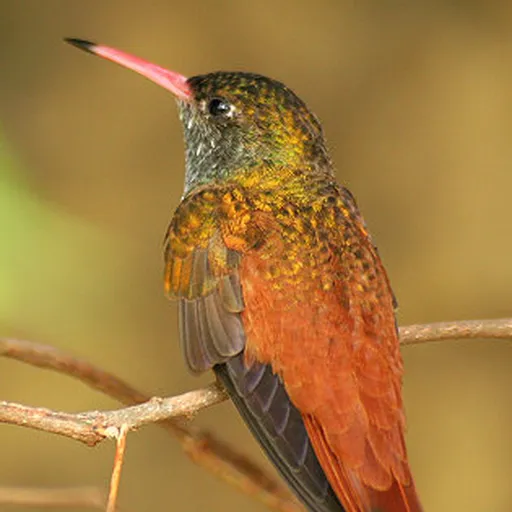
Amazilia Hummingbird
Amazilis amazilia
Listen
XC250457 · Niels Krabbe · Guayas: 3 km E Pacoa Beach, Ecuador · CC BY-SA 4.0
Overview
The Amazilis amazilia is the sole species in the genus Amazilis, belonging to the 'emeralds' tribe of hummingbirds. It is native to western Ecuador and Peru, where it occupies a wide range of semi-arid to arid environments. The species comprises six subspecies that differ primarily in the coloration of their throats and bellies.
Identification
- Measures 9 to 11 cm in length and weighs between 4.5 and 6.5 g, with females generally being slightly lighter than males.
- Features a straight, medium-length, pinkish-red bill with a distinct black tip.
- Males of the nominate subspecies display golden-green upperparts with rufous tails and a glittering golden- to turquoise-green throat, while females share similar plumage but include white on the chin and throat.
- Produces a variable, descending series of 4 to 10 squeaky notes, often interspersed with calls described as 'tsip' or a dry 'zrrt'.
Habitat
This species favours open semi-arid to arid landscapes such as scrublands, thorn forests, xerophytic steppe, and deserts, while rarely venturing deep into forested areas. It is also frequently found in cultivated areas, city parks, and gardens. Elevational ranges vary by subspecies, extending from sea level up to approximately 2,700 m in certain sub-montane zones.
Diet
The Amazilis amazilia primarily forages for nectar from plants with medium-length flowers, including species such as Erythrina, Psittacanthus, Salvia, and Justicia. Males are territorial and actively defend feeding patches from other hummingbirds and bananaquits. Although nectar constitutes the main source of food, the bird also consumes small insects and spiders, with a time-budget study indicating that only about 2% of its daily activity is spent defending territory.
Did you know?
The specific epithet 'amazilia' is derived from the name of an Inca heroine in Jean-François Marmontel's novel Les Incas, ou la destruction de l'Empire du Pérou.