
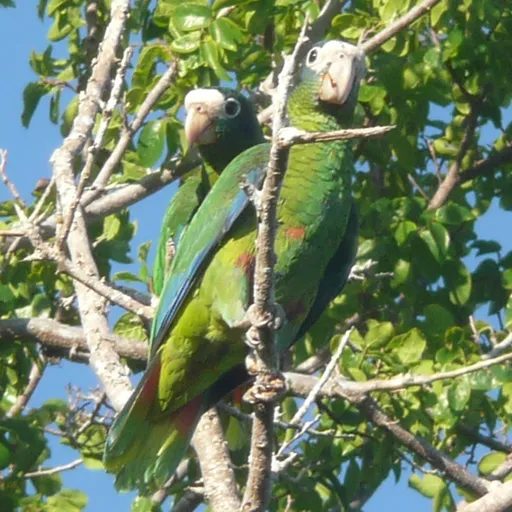
Hispaniolan Amazon
Amazona ventralis
Vulnerable
Overview
The Hispaniolan Amazon, or Hispaniolan parrot (Amazona ventralis), is a species of psittaciform bird endemic to the island of Hispaniola, which includes the Dominican Republic and Haiti. Classified as Vulnerable on the IUCN Red List, this species has suffered a significant decline during the twentieth century, with its range once limited to inland mountains before becoming more typical in metropolitan cities such as Santo Domingo.
Identification
- Bright green plumage with blue edges, featuring a noticeable white forehead, light beak, white eye-ring, blue ear patch, and maroon belly patch.
- Body length measures approximately 28 centimetres, with an adult weight of around 250 g.
- Possesses a large, robust horn-coloured bill and brown eyes with pale feet.
Habitat
Inhabits a variety of wooded environments up to 1,500 metres above sea level, ranging from arid savanna palm groves and pine forests to humid mountain forests. Populations are often restricted to forest reserves and national parks such as Jaragua, Cotubanamá, and Los Haitises, though they frequently forage in cultivated lands like banana plantations and cornfields.
Diet
Consumes seeds and fruits, specifically from species such as Caesalpinia, Psidium, and Ficus. They forage in forests, groves, and thickets where suitable fruits and seeds are available, often venturing into agricultural areas.
Did you know?
First scientifically described in 1776, the species was known as early as 1535 to the Spanish historian Gonzalo Fernández de Oviedo, who noted that these birds, called 'Higuacas' by the Taíno, were very talkative when taught to speak human words.
Sources
- Wikipedia · CC BY-SA 4.0
- Wikidata · CC0 1.0