
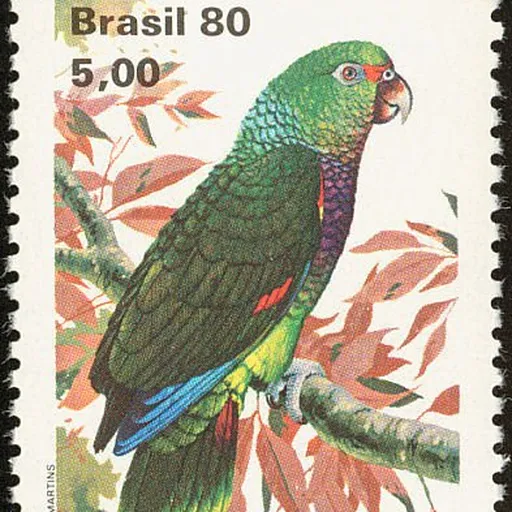
Vinaceous-breasted Amazon
Amazona vinacea
Endangered
Overview
The vinaceous-breasted amazon (Amazona vinacea) is an endangered parrot species in the family Psittacidae. It is found in a disjunct range across parts of South America, specifically Argentina, Brazil, and Paraguay.
Identification
- Length of 30 to 36 cm with mostly green plumage, featuring a lilac breast, red lores and forehead, and a turquoise nape.
- Red carpal edge, speculum, and the base of the outer tail feathers, while the primaries have blue to black ends.
- Bill with a rosy pink to red base and a horn-colored tip; red-orange to chestnut iris surrounded by pale gray skin.
- Gray legs and feet.
- Vocalisations include "creo creo" or "crau crau", and "wout-wout-" or "wi-rout wi-rout".
Habitat
Inhabits a wide variety of landscapes within the Atlantic Forest biome, concentrating in mixed forest with large amounts of paraná pine. Also occurs in small forest patches, young secondary forest, pastures, grasslands with scattered trees, plantations of introduced pine and Eucalyptus, and around towns. Distribution spans Brazil's São Paulo state south to Rio Grande do Sul, eastern Paraguay, and far northeastern Argentina's Misiones Province.
Diet
Forages mostly in tree-tops, often in flocks, feeding on seeds, fruits, buds, and flowers of more than 30 native and introduced plant species. Seeds of paraná pine serve as a primary food source during winter.
Did you know?
Nesting is often hindered by Africanized bees (Apis mellifera scutellata), an invasive species that occupies potential nest cavities before the parrots can use them and sometimes takes over active nests.
Sources
- Wikipedia · CC BY-SA 4.0
- Wikidata · CC0 1.0