
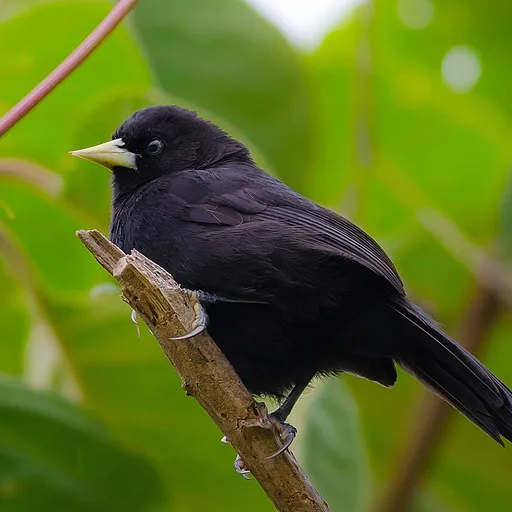
Yellow-billed Cacique
Amblycercus holosericeus
Least Concern
Listen
XC242085 · Niels Krabbe · Morona-Santiago: mid Gualaceo-Limón road, Ecuador · CC BY-SA 4.0
Overview
The yellow-billed cacique (Amblycercus holosericeus) is a species of bird in the family Icteridae found across Mexico, Central America, and parts of northern and central South America. Classified as Least Concern by the IUCN, this species is believed to be a sedentary year-round resident throughout its extensive range, though some elevational movements are suspected in the Andes.
Identification
- Males are entirely black, while females appear slightly slaty black; both sexes possess a pale yellow iris and gray legs and feet.
- Males measure approximately 21.5 cm in length, and females about 20.5 cm, with all subspecies featuring a long bill that is chisel-shaped at the tip and yellow in colour.
- Males produce loud duetting calls described as "Teeer-purr'weeuur!" or ringing whistled notes, to which females reply with long down-slurred whistles followed by a harsh nasal chatter.
- The species is generally secretive, often observed foraging in the understory rather than displaying openly.
Habitat
This bird inhabits dense undergrowth, primarily at forest edges, clearings, secondary forest, and abandoned agricultural fields. In the Andes, it greatly favours stands of Chusquea bamboo. Its range spans from sea level up to 3,500 m, with specific elevation preferences varying by region.
Diet
The yellow-billed cacique feeds mostly on insects, occasionally on other arthropods and small invertebrates, and rarely on fruit. It forages like a woodpecker by hammering and probing bamboo, stems, and rotten wood, or by inserting its closed bill into a substrate and opening it to expose prey. Foraging typically occurs in pairs, family groups, or within mixed-species flocks in the understory.
Did you know?
In at least Costa Rica, the shiny cowbird (Molothrus bonariensis) acts as a frequent brood parasite of the yellow-billed cacique. The female cacique alone incubates a clutch of two pale blue eggs with black markings, while both parents are involved in provisioning the nestlings.
Sources
- Wikipedia · CC BY-SA 4.0
- Wikidata · CC0 1.0