
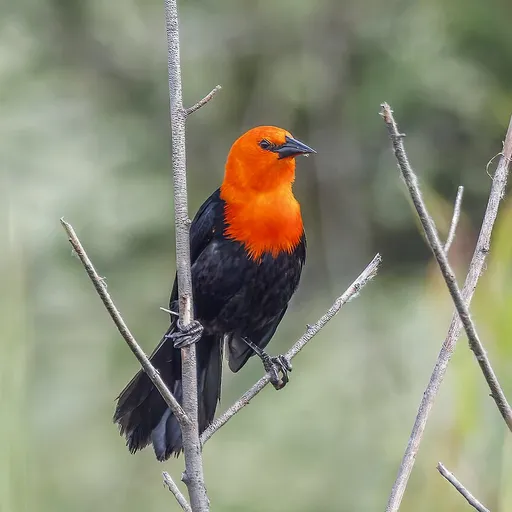
Scarlet-headed Blackbird
Amblyramphus holosericeus
Least Concern
Overview
The scarlet-headed blackbird (Amblyramphus holosericeus) is a species of bird in the family Icteridae. It is the only member of the genus Amblyramphus and is classified as Least Concern on the IUCN Red List.
Identification
- Males average 25 cm in length while females are slightly smaller at 22.5 cm.
- Adults feature a scarlet-red head, neck, upper breast, and thighs contrasted with glossy black plumage elsewhere.
- Characterised by a sharp, chisel-shaped black bill and black legs.
- Juveniles are brownish black with a yellowish wash on the throat and breast.
- Display songs include rattles or a nasal buzz, often described as "viti-tju vid-dertjuuh", while contact calls sound like a long, descending whistle.
Habitat
This species primarily inhabits marshes with extensive stands of sedge, cattail, and arrowroot, as well as nearby grasslands and agricultural fields. Its range is disjunct, covering parts of northeastern Argentina, Uruguay, southern and central Paraguay, Brazil, and Bolivia, generally not exceeding 600 m in elevation.
Diet
Feeds mostly on insects extracted from plant stems using its chisel bill, with occasional consumption of small frogs. During the dry season, it supplements its diet with the seeds of cultivated crops such as maize and sorghum.
Did you know?
The bird is a solitary and highly territorial breeder in which the male actively guards the nest while the female incubates eggs for 13 to 14 days. Although its nests are parasitised by the shiny cowbird, the incidence is low due to the male's aggressive defence.
Sources
- Wikipedia · CC BY-SA 4.0
- Wikidata · CC0 1.0